Articles for tag: Christmas

GIVING WITNESS TO THE TRUE CHURCH

Orthodox Christians all over the world have received the unchanging Christian Faith, passed down from the Holy Apostles to their successors, and continue to practice it today in the One Holy Catholic and Apostolic Church – The Orthodox Church.
%%tb-image-alt-text%%

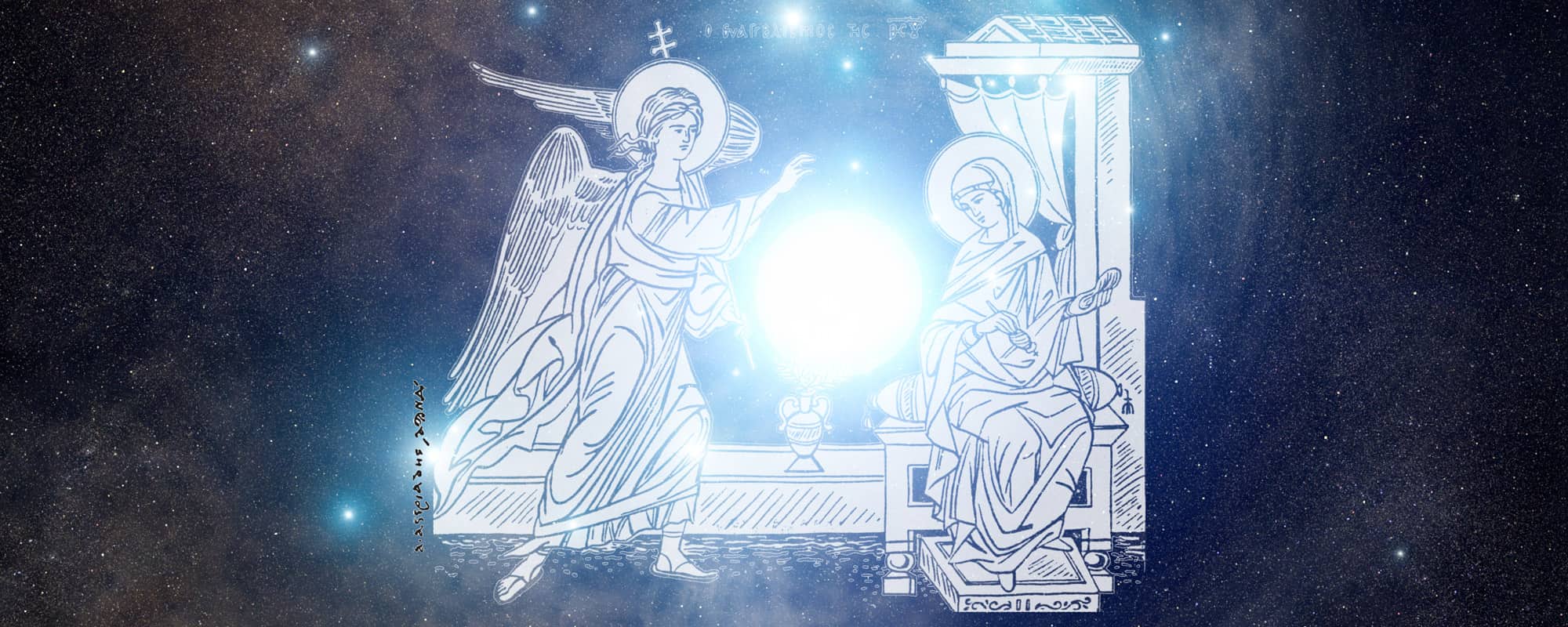
“The Son of God becomes Son of the Virgin”

“Today is the beginning of our salvation…
The Son of God becomes son of the Virgin.”

(Troparion of the Annunciation feast)

From all eternity, even before God created the world and the human beings, He knew of the fall of Adam. Since He is outside of time, He sees everything at once. Therefore, as He created,

  • the world and everything in it
  • the matter and everything that derives from it
  • the atoms and the molecules, and everything made out of them
  • the energy and all the forces of the universe
  • the galaxies and the inter-galactic matter
  • life in all its forms
  • and all the other worlds He created, visible and invisible, of which we only have a glimpse…

…as God created His cosmos, He also provided for it. Everything followed His infinite wisdom and His intelligent plan. It came into existence, receiving its form and constitution because God willed it.

Even before the fall, God had provided for the redemption of the human beings, the pinnacle of His creation. From all eternity God saw how, when, and by who the redemption would be accomplished. Thus we see that immediately after the transgression of the first-formed people in His image, God gave them the first promise of their redemption in the future, at the appointed time His inscrutable will had determined. Thus He told the serpent:
“I will put enmity between you and the woman,

and between your offspring and hers;

he will strike your head,

and you will strike his heel.” (Gen. 3:15)

From the very moment of the transgression, God, who cannot abandon the work of His hands, provides for the redemption of His creation. Though fallen, because of their misjudgment, act of disobedience and mistrust in their Benefactor, the Good Lord, has in store a plan that will actually bring the human beings closer to Him than if they had never sinned.

But that’s a job that even the omnipotent and omniscient God could not do by Himself. He also needed the cooperation of the human beings He created, because He wanted a free response from them, not a course of action about which they would have no say. God wanted the human beings to exercise the highest gift bestowed on them, their free will.

The appointed time, the kairos, came, when a young virgin appeared. She responded to God’s love so warmly, that she attracted Him as a lightning rod attracts lightning. Thus the incarnation of the Son of God could now take place, because the holy Virgin was born, who aligned herself perfectly to the will of God, and thus conceived the source of Life, the Lifegiver Christ.

The holy Virgin was not used by God like a test tube or as a surrogate mother to give birth in the flesh to the Second Person of the Holy Trinity. As Tertullian put it (all the way back in the second century), Christ was not born, as the Gnostics contended, “through the Virgin” nor “in the Virgin”, but “by the Virgin” (De Carne Christi 20). St. Gregory the Theologian declares that, “whoever does not accept the holy Mary as Theotokos (Birth-giver of God), is Godless” (ep. 101).

The Fifth Ecumenical Council in its sixth canon repeated the anathema voiced by St. Cyril of Alexandria, (and I bring the canon here in its entirety):

If anyone declares that it can be only inexactly and not truly said that the holy and glorious ever-virgin Mary is the mother of God (Theotokos), or says that she is so only in some relative way, considering that she bore a mere man and that God the Word was not made into human flesh in her, holding rather that the nativity of a man from her was referred, as they say, to God the Word as He was with the man who came into being; if anyone misrepresents the holy synod of Chalcedon, alleging that it claimed that the virgin was the mother of God only according to that heretical understanding which the blasphemous Theodore put forward; or if anyone says that she is the mother of a man (anthropotokos) or the Christ-bearer (Christotokos), that is the mother of Christ, suggesting that Christ is not God; and does not formally confess that she is properly and truly the mother of God, because He who before all ages was born of the Father, God the Word, has been made into human flesh in these latter days and has been born to her, and it was in this religious understanding that the holy synod of Chalcedon formally stated its belief that she was the mother of God: let him be anathema.

In great humility the holy Virgin recognized her pivotal role in the plan of salvation, and thus, cognizant of her role, she exclaimed in her Magnificat,

“All generations shall call me blessed” (Lk. 1:48).

Even the founder of Reformation, Martin Luther, in his commentary on the “holy canticle” (as he called the Magnificat) written in 1521, referred to the “blessed Mother of God” (he calls her that way) as the example who “teaches us how we must love and praise God.” He continues,

“She wishes to be the greatest example of God’s grace, so as to encourage all to confidence and praise of divine grace.” (Martin Luther, Religious Writings, edited by V. Vinay, Turin 1967, pp. 431-512).

These are great mysteries, my friends, difficult to delve into, and impossible to comprehend. How did the Second Person of the Holy Trinity indwelt the most pure womb of the holy Virgin is a great mystery and an inexplicable miracle, even for the angelic powers. “That is why,” St. Gregory Palamas says,

“when the holy Virgin asked the Archangel Gabriel, ‘How can this happen to me?’ he was unable to say the manner, but he only said, ‘The Holy Spirit will come upon you, and the power of the Most High will overshadow you.’” (hom. 14)

Thus the holy Virgin conceived the Son of God, who now becomes her Son.

We don’t want to turn this sermon into moralizing, but the subject begs us to address the subject of when does life begins, which, of course, is not at all a question within the Orthodox Church, but only among the unenlightened ones. As with many other topics, Orthodox theology is at odds with prevailing opinions among legislators, politicians, ethicists, medical professionals, philosophers and even certain religious groups.

For the Orthodox Church human life begins at the very instant of conception. This is indicated by the feasts of three conceptions the Church celebrates: those of St. John the Baptist, of the most holy Theotokos, and of today’s feast, the Conception of Christ our God, known as the Annunciation of the most holy Virgin. Already in the fertilized embryo divinity and humanity are united “without confusion, without change, without division, without separation” (The Chalcedonian Decree).

The question has been raised: when and how does the soul enters the body? Our answer as to when, as the Church teaches, is that there is no time in which the body existed without the soul, therefore the embryo is endowed with a soul at the very moment of conception. As to how did it acquire it we answer that the spiritual life is bound inextricably with the physical life, in an inseparable unity. The soul does not preexist (a heretical teaching condemned by the Church, 5th Ecumenical Council). God does not create it separately. Although it has an existence apart from the body after death, it does not have a separate existence prior to the conception. Therefore the human being is complete, body and soul, at the very moment of conception.

Not only does the embryo have a soul from the very moment of conception, it even receives the grace of the Holy Spirit. The Archangel Gabriel told Zacharias that the son his wife would give birth to would be great and that

“even before his birth he will be filled with the Holy Spirit” (Lk. 1:15).

In fact, St. John the Baptist, when only a six-month old fetus, recognized Christ (who had just been conceived by the holy Theotokos) from the womb of his mother. “Leaping” in his mother’s womb, since he did not yet possess a voice, he transmits the prophetic utterance to his mother, who then calls her cousin Mary “mother of my Lord”:

“why has this happened to me, that the mother of my Lord comes to me? For as soon as I heard the sound of your greeting, the child in my womb leaped for joy” (Lk. 1:43-44).

With in-vitro fertilization already taking place and with human cloning around the corner, one may wonder: what happens in such cases, when, and how does a fertilized egg become a complete human being? But of course in the same way as through the natural and physiological means. That’s not what we should be thinking. What we should be thinking is, Do we have trust in God, as Joachim and Anna did, and as Zechariah and Elizabeth did, who prayed to God even in their old age to give them a child? They continued to pray when others of little faith would have given up.

Someone asked me if a pregnant woman should receive holy Communion. A pregnant woman should pray for her unborn child, preferably out loud, so that the child will hear the prayers and be sanctified through them. A pregnant woman should likewise read from the holy scriptures and the lives of the Saints out loud, cense her home and the holy icons, and drink some holy water first thing in the morning every day, go to confession, and yes, receive regularly the holy sacraments, so that the fetus will grow both physically and spiritually. Thus the parents will provide the proper conditions for the further spiritual development of their child.

My dear brothers and sisters in Christ: May the Lord, whose Incarnation we celebrate today, through the intercessions of His all immaculate Mother, illumine our minds and strengthen our wills, particularly those of parents and future parents, to know and to do what is pleasing to Him. Amen.

GIVING WITNESS TO THE TRUE CHURCH

Orthodox Christians all over the world have received the unchanging Christian Faith, passed down from the Holy Apostles to their successors, and continue to practice it today in the One Holy Catholic and Apostolic Church – The Orthodox Church.
%%tb-image-alt-text%%

How to give yourself Christ as a gift

Did you leave a very special person off your Christmas shopping list this year? That very special person, neglected and forgotten by most of us is… you! It’s never too late to treat ourselves with the greatest gift of all—Christ! No one else can give Him to us! Here’s how.

  • By following His commandments, especially the commandment to love God…
  • By quickly rising and asking for God’s forgiveness…
  • By forgiving and forgetting…
  • By turning the other side…
  • By walking away, when we have to walk away; and by making a stand, when we have to make a stand…
  • By saying, when we are about to do something—anything: Lord, help me. Bless me. Guide me to do Your will, to never offend You. Thank You, Lord.
  • By saying often (as often as we breathe, if we can): “Lord Jesus Christ, Son of God, have mercy on me, a sinner.”
  • By saying: I believe in You, Father, Son and Holy Spirit, One God; and by learning the Creed by heart, if you don’t already know it.
  • By cutting out the noise! By resting our tongue and mind. By being quiet, and by letting God speak to us, so we can hear Him.
  • By helping a person in need, feeding him, providing shelter for him, caring for him, visiting him, telling him a kind word.
  • Especially, by preparing ourselves through prayer, fasting, penitence, “fear of God, faith and love”, to receive the divine Eucharist.

GIVING WITNESS TO THE TRUE CHURCH

Orthodox Christians all over the world have received the unchanging Christian Faith, passed down from the Holy Apostles to their successors, and continue to practice it today in the One Holy Catholic and Apostolic Church – The Orthodox Church.
%%tb-image-alt-text%%

Christ is Born! The Katavasiae of Christmas chanted in English

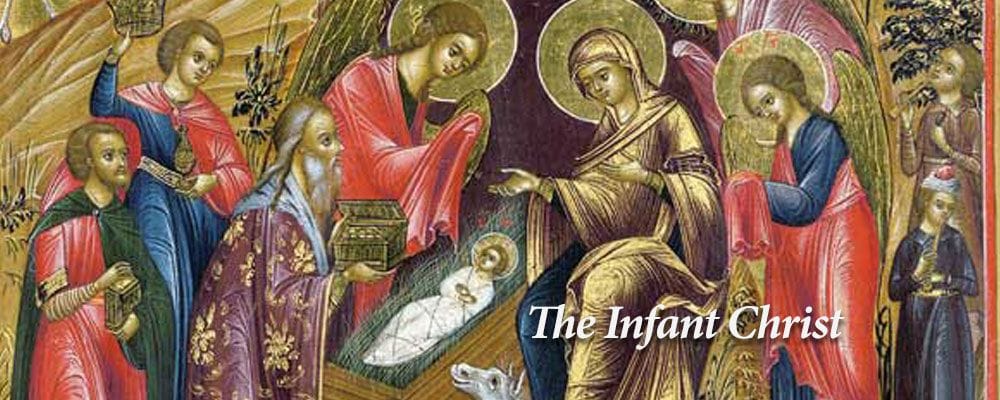
infant christ

The nine odes of the Katavasiae of Christmas, chanted in English, by Fr. Emmanuel Hatzidakis and Anthony Hatzidakis. Rendering in English by Fr. Emmanuel Hatzidakis (1991).
Katavasiae of Christmas.mp4 from Orthodox Witness on Vimeo.

The nine odes of the Katavasiae of Christmas, chanted in English, by Fr. Emmanuel Hatzidakis and Anthony Hatzidakis. Rendering in English by Fr. Emmanuel Hatzidakis (1991).

Katavasiae of Christmas

1. Christ is born: raise your praise to Him!
Christ came down from heaven: come, welcome Him!
Christ is on earth: be filled with joy!
Sing to the Lord and praise Him, Heaven and earth,
and with joy and gladness
praise Him, Nations of the earth, for He is glorified!
 

3. O let us cry saying
to the Son who without alteration was born
before all ages of the Father
and was born of a Virgin
without seed in these days, Christ our God:
“You raised and lifted up our low estate:
Holy are You, O Lord.”
 

4. Rod out of the root of Jesse sprung
and flower blossomed from its stem,
from a young Virgin You came forth, O Christ,
O Praised One, and have appeared
from a dense shadowed Mountain.
From an untouched Maid You were incarnate,
O God immaterial: Glory to Your power, O Lord our God!
 

5. As Father of mercies and God of our peace
You have sent unto us Your Great Messenger,
of Your Great Counsel, granting peace to all the human kind.
Thus guided toward the true light
of God’s divine knowledge,
since the early dawn we pray,
singing Your praises, Lover of mankind.
 

6. Jonah was thrown out, like a newborn from the womb,
as he was received by the seafaring beast,
while the Word of God,
having dwelt in the Virgin and taking her flesh,
passed through her, yet He preserved her incorruptible.
She who gave Him birth was kept unharmed,
for the Lord was not subject to any change.
 

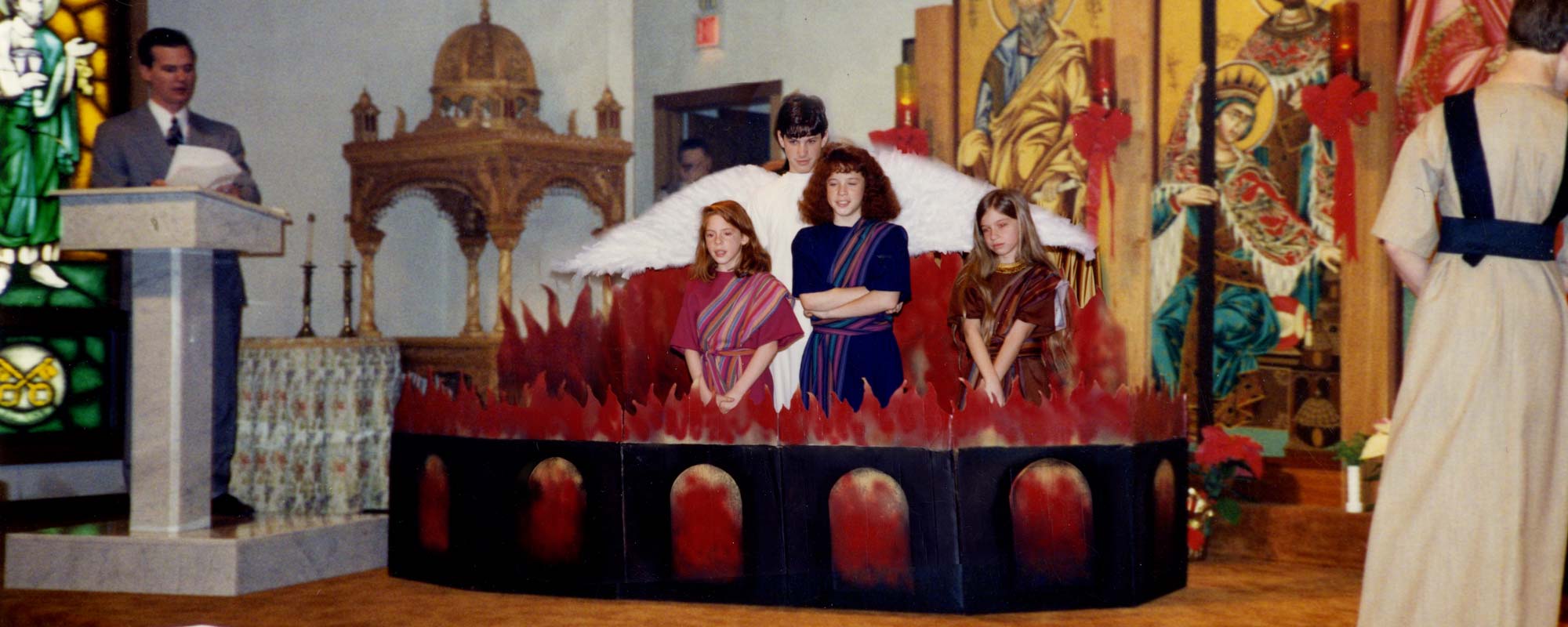
7. The three youths who were brought up in the true faith,
having scorned the impious and blasphemous decree,
they were not dismayed not scared by threats of fire,
but were singing as they stood among the burning flames:
“God of our Fathers: Be blessed unto the ages.”
 

Verse: We praise the Lord and bless Him,
adore and worship our Lord and God.

8. Verily the dewy furnace was a figure
of a great supernatural wonder;
for it left unharmed the three youths in its midst,
as did the flame of divinity,
which had dwelt in the Virginal womb.
Therefore, let us sing a hymn of praise to Him:
“Let the whole of creation bless and exalt the Lord
and extol Him highly unto the end of ages.
 

Verse: Magnify, O my soul, her who is more honored
and who is more glorious than the Hosts of Heaven.

9. I see a most startling and wonderful mystery!
for the cave became heaven,
throne of the Cherubim the young Virgin,
the Manger a cradle,
on which has reclined the Uncontainable,
our God Jesus Christ:
Him let us praise in hymn and magnify.

* The Second Ode is usually omitted, being of penitential character.

Photo of author
The Orthodox Witness website is published by Anthony Hatzidakis.

GIVING WITNESS TO THE TRUE CHURCH

Orthodox Christians all over the world have received the unchanging Christian Faith, passed down from the Holy Apostles to their successors, and continue to practice it today in the One Holy Catholic and Apostolic Church – The Orthodox Church.
%%tb-image-alt-text%%

Why did God Become Man?

The following summary of the mystery of the economy by the renowned theologian of our times, Protopresbyter and Professor Emeritus of the University of Athens, Fr. George Metallinos is an appropriate post at this time of the year, as we have arrived at the great feast of the Nativity in the flesh of our Lord, God and Savior Jesus Christ.

Of special interest to me is His statement that “Christ was born free from all the consequences of sin, suffering and death,” which confirms the thesis of my book, “Jesus: Fallen?” namely, Christ assumed our human nature, free from sin and its consequences (corruption, suffering and death), but voluntarily and in total freedom allowed the blameless passions to act on His deified humanity not out of necessity, but by exercising total control over them. [Fr. EH]

Fr. George Metallinos

Modern man, tired from the various celebrations that typically end up fulfilling societal conventions, faces Christmas without approaching it internally. Most people, even the otherwise religious ones, see Christmas as a big family feast, which offers the opportunity to bring together scattered family members around Christ laying in the manger, under the Christmas tree that came out of the closet to be decorated in a corner of our house for a few days. But today, each one of us is called to ask himself the question: What does Christmas mean to me? One makes personal a broader question: “Why did God become man?” — a question that occupied the greatest minds of history.

“… so we might receive adoption as sons” (Gal. 4:5)

Christmas is the birth of the eternal God from a human being, a Mother, the Virgin Mary, which marks the entrance of God into history. What the sages of the world could not approach, even with their imagination, in a given time became reality. The uncreated God becomes what He was not, for our salvation. He whom the entire universe could not contain is “contained in a womb.” The infinite God is self-confined within the human nature He received from the most pure Theotokos. In the language of our holy Fathers this is called “condescension.” God condescends. He who is beyond every size and measurement becomes small. The inconceivable by any power of our senses is felt and becomes tangible and visible. Why? — To enter into communion with us. God communicates with us in our own language, to enable us to accept Him and understand Him. Had He spoken the language of heaven, we could not understand Him; therefore He speaks our language, the earthly language (Jn. 3:12).

By freeing us from the curse of the Law and by uniting us with Himself with the Holy Baptism, He grants us the adoption, and renders us children of God by grace.

Man was created “in the image” of Christ. Man’s standard (his “archetype”) was Christ, as God-man. Man ought to have elevated himself to this “archetype,” by purifying himself and by loving God so much, that God would come and dwell in him and manifest Himself in history as God-man. The fall of man was the derailment from this course. But God’s love corrects man’s failure, so He accomplishes what man had failed to achieve. When the appointed time of the incarnate economy had come, God sent forth His Son (see Gal. 4:4), which means: God himself came “of His own free will,” as the poet of the Akathist Hymn will say so aptly, to “redeem” us from the curse of the Law and to grant us the adoption. The Incarnate God was “born under the law,” He was circumcised, and performed everything required by the Old Testament Law, and fulfilled (Mt. 5:17) the entire Law, staying away from any sin. Thus the Lord remained out of the curse of the Law, which says: “Cursed be he who does not confirm the words of this law by doing them” (Deut. 27:26). Thus He fulfilled the entire Law, rescuing us from the curse of the Law, since we could never keep all its commandments. By freeing us from the curse of the Law and by uniting us with Himself with the Holy Baptism, He grants us the adoption, and renders us children of God by grace. Our adoption, then, our union with Christ, our deification, is the purpose of His incarnation. This is the only “destiny” of man, the only purpose of our lives.

Foundation of our salvation

With His incarnation “from the Holy Spirit and the Virgin Mary” our Christ was born free from all the consequences of sin, suffering and death. But as out of His love for humanity He became incarnate, so out of love He accepted to assume the consequences of our sin: suffering and death.

Out of His love for humanity He became incarnate, so out of love He accepted to assume the consequences of our sin: suffering and death. He assumed the whole human reality, apart from sin itself. This He did to crush our sin and its consequences, to His death, in His human nature.

He assumed the whole human reality, apart from sin itself. This He did to crush our sin and its consequences, to His death, in His human nature. This is why Christ accepted to arrive at the passion of the Cross. This is why loaded with our sins He descended to Hades. He went down to the last step of our fall, to put to death our sin on His Cross, to bury it in the depths of Hades, and to brilliantly raise our human nature, all enlightened, lifting it up to the kingdom of the Triune God with His Ascension. So here is why Orthodoxy is not limited to the sentimentalities that the cross and the passion of Christ generate, as it happens outside the Church—because the foundation of our salvation is the incarnation of the Divine Word. Without the Incarnation and Christ’s Nativity, His crucifixion, death and resurrection would be inconceivable. St. Maximos the Confessor says that the Incarnation of the Word of God “is the blessed end for which all things were created.” In other words, all creation was made for the Incarnation, since the deification of man and the sanctification of the world is the sole purpose of creation.

Participation in salvation

The divine Logos with His incarnation united in His Person the created with the uncreated, God with man. But what happened to the individual human nature of Christ, also happens to everyone’s. With His incarnation Christ united us all with Him. With our baptism we participate in the fact of the Incarnation, we are implanted in the deified human nature of our Christ, in order to be buried (die) with Him, and resurrect with Him. But to make our salvation complete, our person (our ego, our will) must also be united with Christ. And this happens when we are purified from our passions, and let the Holy Spirit dwell within us. The Apostle Paul reminds us of this. Proof that we have become worthy to be “sons” (children) of God is the presence of the Holy Spirit within us, who prays in our hearts (Gal. 4:6). It is the “noetic prayer” or “prayer of the heart,” about which speak our holy Fathers. With the grace and synergy of the Holy Spirit we remain united to Christ, and our entire life is sanctified. With the grace of the Holy Spirit we participate in the salvation in Christ; we are saved; we are deified. The life of the Church is a continuous struggle of the faithful to remain in the grace of God, to have within us the Holy Spirit, to sanctify our entire life, personal and social—to transform our whole life to the life of Christ.

Originally published in Orthodoxos Typos, on Dec. 18, 2015
Translated from Greek by Fr. Emmanuel Hatzidakis

GIVING WITNESS TO THE TRUE CHURCH

Orthodox Christians all over the world have received the unchanging Christian Faith, passed down from the Holy Apostles to their successors, and continue to practice it today in the One Holy Catholic and Apostolic Church – The Orthodox Church.
%%tb-image-alt-text%%

What was the Lord Jesus like as an infant?

infant christ

This post is taken from correspondence between Fr. Emmanuel and S.N., who has read Fr. Emmanuel’s book, Jesus: Fallen?. S.N. raises questions about the infant Christ. Although Holy Scripture does not provide many details about the early life of the Lord, Fr. Emmanuel draws from patristic knowledge to provide some answers. His comments to S.N. are in blue.


Well, I read the book [Jesus: Fallen?] and I will tell you, that who Jesus is and what He did are more amazing than I ever even knew to consider.

Voluntary, voluntary, voluntary…In freedom, without compulsion…you hammered these points home throughout the book and for that I am glad. I’m glad the hammering didn’t turn you off, but I had to nail that one down. I really had no idea how I had been affected by the postlapsarian perspective, but as I read through the book, preconceived notions that I had were challenged and as I talk about this subject with friends, even more preconceptions seem to surface and are challenged. I wonder at times, if I understand the gospel at all. We are all there together. We draw with our buckets from the inexhaustible ocean of infinite God.

I am not discouraged but glad that I have been made to consider.

I have a question. I would like, if you are inclined, just a bit of clarification.

Was Christ born as a helpless baby?

One time period of Jesus’ life was not extensively covered in the book, and that was His infancy. In my discussions with a friend, who is a Reformed pastor, He quoted Bavinck below, and I am most interested the part where Bavinck used says “born as a helpless baby”:

“Reformed theologians, however, have so construed the communication of the gifts as to make possible a human development in Jesus. Although he was the second Adam, Christ was nevertheless another person. Adam was created as an adult, was given paradise as place of residence, and was not subject to suffering and death; Christ, however, was conceived by the Holy Spirit and born as a helpless baby. He was not placed in a paradise For sure our earth is not Paradise. But what is Paradise? “Her (the Virgin’s) womb was shown to be a spiritual Paradise, in which is found the God-planted Tree (Jesus)” (Holy Nativity, pre-festal apolytikion) but came into a world that lies in the evil one He is not subject to anything evil, because He is the Holy One. [I think that means that Jesus was born into the world which is under the sway of the evil one] he was vulnerable to temptation on every side. Christ is the “stronger One” who, as I say in the book (p. 198), “assails the ‘strong one,’ i.e., the devil, overcomes him, takes away his armor and despoils him (Lk. 11:22).” (see also p. 296) He is the One over whom the ruler of this world has no power. No one who consciously believes in the divinity of Jesus Christ can say that He was vulnerable to temptation. he bore a nature that was susceptible to suffering and death. his was not the human nature of Adam before the fall; For sure, because Christ’s human nature was incomparably loftier than Adam’s, being perfect, not potentially as it was Adam’s but actually, and it was united hypostatically with divinity, whereas Adam’s did not share such intimate union with God, which includes interpenetration rather, God sent his Son in the likeness of sinful flesh, that is, in the flesh that was the same in form and appearance as sinful flesh (Rom. 8:3)” The subject of likeness was discussed at length in my book (p. 338ff.). His body is “in the likeness of sinful flesh,” whereas ours is a flesh of sin (p. 342).

Bavinck goes on to note that it isn’t plain in Scripture, and that Reformed theologians disagree as to several aspects of the nature of the hypostatic union of the divine nature and human nature in Christ. This includes whether or not Jesus was susceptible to illness and death, seeing that He had the “power to lay down his life and was not automatically – aside from his will – subject to death. From ancient times, therefore, opinions on this issue were divided.” Not among the Orthodox Christians, as my study shows.

As I point out in the book (pp. 14-15), Reformed theologians do not follow their own founder who, as far as his teaching on the humanity of Christ is concerned, seems to be orthodox (see also pertinent discussion on pp. 8, 11, 31 (note 69), 129-130, 258 (note 47), 330 (note 55), 354, 358, 429-30, 507 and especially 242-43, and in passim). I think your friend, and his colleagues, would benefit from a study of our Christian roots, where he can find the Apostolic Church and its continuity through time, the sub-Apostolic Church that followed it and the Church of the Apologists and on to the Fathers of the Church, all the way to the present.

Is it accurate to say that Jesus was born as a helpless baby? Certainly not. The almighty Son of God was neither helpless nor vulnerable to temptation or to anything else, even in His humanity. For sure He submitted to our misery, however He endured human weakness, suffering and death to overcome the one who uses them for his evil purposes, and thus grant us His victory.

I am guessing that the word “as” might be important. He was likely born “as” a helpless baby, or in the likeness of a helpless baby, but I am guessing that God incarnate even as a baby was in no way helpless. You are correct. He was a real human baby, not in the likeness of a human baby, yet He was unlike any other human baby, because that baby was divine; His body was the body of the Son of God. I am guessing that a 1 day old baby Jesus could just as easily call 10,000 angels, as could a 33 year old Jesus. Yes. He is the eternal Son of God, the agent of every human thought and action. But maybe I am turning the human Jesus into a phantom or a poser with this type of logic? Wondering about His infancy made me ask myself, did Mary and Joseph flee into Egypt because Jesus was helpless or was this flight into Egypt not from a concern for His safety but to fulfill a prophecy, or for some other reason? Mary, the most holy Virgin, and Joseph His putative father did what they were expected to do: protect the infant from harm. Not doing so would be to tempt God, as the Lord would have done had He cast Himself down from the pinnacle of the temple to prove He was the incarnate God.

Did the infant Christ use his human will?

Another question that came to my mind concerned the human will of Jesus. At what point did His human will become part of the equation? I understand that His human will was always involved in voluntarily allowing the blameless passions to act on His sinless body, but this seems to become an odd idea when you consider Jesus as a 1 day old infant. Did He hunger at 1 day old? Yes, He did. If yes, how was this one-day-old infant able to consent with His human will? The incarnate, almighty Son of God lived as a one-day-old infant does. Therefore He experienced hunger, and He had a need to sleep as any other infant does. Yet He could not experience harm even if He were deprived of food and sleep. Oeconomically, His human will was activated, as His human knowledge was, gradually, according to His age.

Adam was immune to harm not because of his nature (otherwise he could not fall), but because of God’s grace that kept him safe and sound. But God’s grace came from outside; it did not spring from within, because for that he had to train himself in virtue, resist temptation, and respond fully to God’s grace. In the process he could fall, as he did fall. In Christ, grace not only was not external, but He Himself in His humanity is the very source of grace. Therefore for Christ to be harmed in any way He would have to will it in His humanity. Christ could exercise His free will since day one of His life, because since His conception He was perfect in His humanity as He was in His divinity. As I say in the book, “His obedience was perfect, because it sprung from the perfect humanity He assumed.” (p. 312) “The Son shares the same divine will with the Father in His divinity. His human will cannot oppose His divine will, since it is the same subject that does both the willing and the acting in both natures.” (p. 314)

Perhaps I am underestimating the capabilities of a not fallen human baby. While, scientifically speaking, we may not fully comprehend what the capabilities of an ordinary human baby might be, the Theanthropos Christ will certainly remain for us an incomprehensible mystery.

As to how can an infant will freely, let’s repeat that the subject of willing, both in His divinity and in His humanity, is the same, the Divine Logos. And because His human will belongs to a divine person, in total freedom it always follows the divine will. Do not say, how can a one day old infant will freely, because the same One who is born leaving His mother a virgin, who appears to Moses and to Daniel in human form before His incarnation, can exercise His human will before reaching the age of reasoning. He who can transform mud into a pupil can make His humanity participant in the mystery of our salvation from the very instant of His birth, or rather since conception. Because before He is even born He bestows the gift of prophecy to St. John the Baptist’s mother, the holy Anna. Let’s not apply strictly the laws of nature to the Lawgiver.

If we find this an obstacle to our faith what shall we say about His incarnation and bodily resurrection and ascension to heaven and His glorious second coming? We should always keep in mind that within His frail body dwells the almighty Son of God who created the world and everything within it. Since His conception the One who dwells in the Virgin’s womb is the eternal Logos. And the Logos cannot be a-Logos, He cannot be a non-Logos, even as an embryo or an infant of one day.

My view expressed here and in the book is based on the Damascene’s statement quoted in the book, that Christ was conceived “not developing the fashion of the body by gradual additions but perfecting it at once.” (p. 421) Christ was fully developed at the very instant of His conception. He was the enhypostatic Wisdom of God since day one. But, as I say in the book quoting Metropolitan Hierotheos Vlahos, He expressed His wisdom in accordance with His age, “because if it had been otherwise, He would have appeared to be a freak.” (p. 443)

To any further objections about the one day old infant Jesus using already His human will we can refer to Mt. 21:16. If God can prepare praise from the mouths of infants and sucklings He can give mature wisdom to a 12 year old and even the full faculty of willing to a one day old – to silence and destroy His enemies and the avenger, who is Satan. And if you want, the verse refers to Christ, as do all the psalms.

I apologize if my questions are foolish. As you know, there are only foolish answers. The questions you raise are serious and well thought out. I trust you will find my answers to be adequate. I am interested to understand and I am coming at it as honestly as I can. You can come back as often as you like. I admire you and commend you because, in imitation of the Bereans, you hunger and thirst for answers that satisfy you and give you rest.

May our Lord, whose Birth we are about to celebrate, enlighten us and guide us to His knowledge, which is beyond all understanding.

Merry Christmas!

In His service,
Fr. Emmanuel


GIVING WITNESS TO THE TRUE CHURCH

Orthodox Christians all over the world have received the unchanging Christian Faith, passed down from the Holy Apostles to their successors, and continue to practice it today in the One Holy Catholic and Apostolic Church – The Orthodox Church.
%%tb-image-alt-text%%

Christmas 1,000 Years Before Christ!

Prophecies Announcing Christ

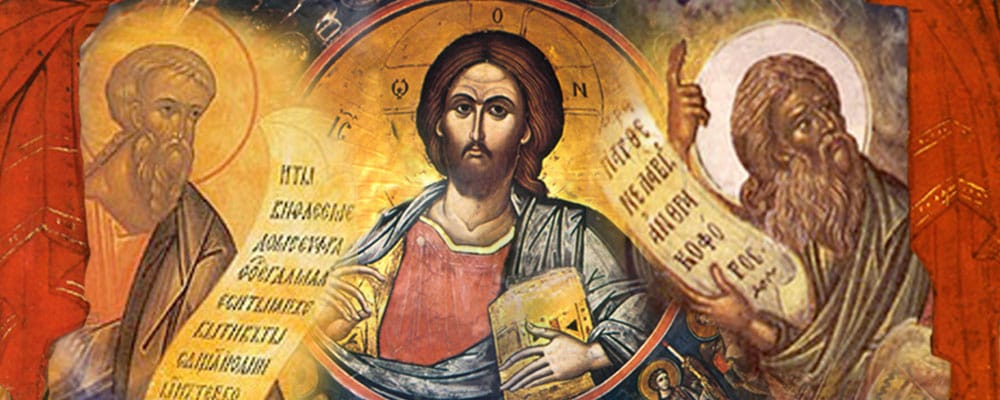
Centuries before our Savior was born, the prophets of the Old Testament, inspired by the Spirit of God, saw and proclaimed His Birth. David (1,000 B.C.), Micah and Isaiah (800-700 B.C.) write the first Christmas hymns before the birth of the Lord.

KING-PROPHET DAVID

“He will live as long as the sun endures,
and as long as the moon, throughout all generations.
He will be like rain that falls on the mown grass,
like showers that water the earth.
In His days righteousness will flourish and peace will abound,
until the moon is no more.
He will have dominion from sea to sea,
and from the River to the ends of the earth.
His foes will bow down before Him,
and His enemies lick the dust.
The kings of Tarshish and of the isles will render Him tribute,
the kings of Sheba and Seba will bring gifts.
All the kings will fall down before Him,
all nations will give Him service”. (Psalm 72:5-11)


 PROPHET MICAH

“But you, O Bethlehem of Ephrathah, who are one of the little clans of Judah,
from you shall come forth for me One who is to rule in Israel,
whose origin is from of old, from ancient days.” (Micah 5:2)


 PROPHET ISAIAH

“Therefore the Lord Himself will give you a sign. Look, the Virgin will be
with Child and shall bear a Son, and shall name Him Emmanuel.” (Is. 7:14)

“The people who walked in darkness have seen a great light;
those who lived in a land of deep darkness—on them light has shined.
For a Child has been born for us, a Son given to us;
authority rests upon His shoulders; and He is named
Wonderful Counselor, Mighty God, Everlasting Father, Prince of Peace.
His authority shall grow continually, and there shall be endless peace
for the throne of David and His kingdom. He will establish and uphold it
with justice and with righteousness from this time onward and forevermore.”
(Is. 9:2.6-7)

“Arise, shine; for your light has come, and the glory of the LORD has risen upon you.
For darkness shall cover the earth, and thick darkness the peoples;
but the LORD will arise upon you, and His glory will appear over you.
Nations shall come to your light, and kings to the brightness of your dawn.”
(Is. 60:1-3)

GIVING WITNESS TO THE TRUE CHURCH

Orthodox Christians all over the world have received the unchanging Christian Faith, passed down from the Holy Apostles to their successors, and continue to practice it today in the One Holy Catholic and Apostolic Church – The Orthodox Church.
%%tb-image-alt-text%%

“What shall we offer You, O Christ?”

Originally preached on Christmas day Liturgy in 2008

Christ is Born!—Glorify Him!

Christ is indeed born, and we praise and glorify His Holy Nativity. However, by the time we hear the Gospel reading of Christmas Day (Mt. 2:1-12), we realize that Christ’s birth is already behind us. The passage is about the events following the Lord’s birth, chiefly the account of king Herod and the Magi. The actual account of the birth of Christ is heard in the Morning Gospel of the Orthros (Matins) service. What most of us perhaps do not know is that on Christmas Day we celebrate not only the Nativity of the Lord, but the adoration of the Magi as well. This double celebration is very ancient. Several hymns address this story (Hypacoe, Kathisma, Canon, etc.). The following reflections address this event.

1. It would be wise on our part to do what the wise men did, namely as they went from the East to worship the newborn King, so let us also, who are from the West, draw near and worship Him. Let us reflect briefly on it. Many people worshipped the Lord. Some did so after He performed a great miracle, others after His Resurrection from the dead. But these wise men worshipped Him before they knew anything about Him.

The emphasis in “worship Him” is on “Him.” Let us not follow  those who “exchanged the truth about God for a lie and worshipped and served the creation rather than the Creator” (Rom. 1:25). If God could lead astrologers from their deception to Him, we too can turn away from today’s idols: the worship of science and technology. Our prized intelligence should not hinder us from recognizing in this lowly, frail creature the Creator of all, and adore Him. Let us then, who know better, glorify Him.

2. The wise men were glad when they saw the star, which led them to “the place where the child was.” How glad were they? “They rejoiced exceedingly with great joy.” That seems to indicate they were pretty happy, wouldn’t you say? What of us? Our hearts also rejoice at the birth of the Savior of the world. He is the source of our happiness, our cause of joy. Let these thoughts be directed to the Son of God, Who, out of love for us, “became man,” to redeem us.

3. It would also be quite appropriate to do as the wise men did, who “presented gifts to Him.” With their precious gifts of gold, frankincense and myrrh they honored Christ as King (gold), Priest (frankincense) and Prophet (myrrh). St. Nikolai of Zica points out that the gifts of the wise men express that which lasts: “After a thousand years, gold still shines, incense burns and myrrh keeps its fragrance.” Let us also offer Him our gift.

This time of the year is about exchanging gifts, isn’t it? It started with the Magi. What do we do when we don’t quite know what to give to someone we love? Some people give cash, or a gift certificate to a clothing store or bookstore. I think nothing is more appreciated than something we ourselves have made. But who has time for such things any more? Walmart is quicker, cheaper (less costly) and more convenient. The question still remains: What shall we offer to Christ?

This year let us present to the Divine Infant our own gifts, our very personal gifts. What might they be? Let us offer to Him our change of life, our renewed spirit, our love and forgiveness for each other, and our complete devotion to Christ our God.

Have a blessed Nativity Season.

This text also appeared in the December 2008 edition of “The True Vine”, the monthly newsletter of St. Luke Greek Orthodox Church, Columbia, MO.
Item added to cart.
0 items - 0,00 $