Articles for tag: Apokreo/meatfare, judgment

GIVING WITNESS TO THE TRUE CHURCH

Orthodox Christians all over the world have received the unchanging Christian Faith, passed down from the Holy Apostles to their successors, and continue to practice it today in the One Holy Catholic and Apostolic Church – The Orthodox Church.
%%tb-image-alt-text%%

Eternal suffering or eternal rewards

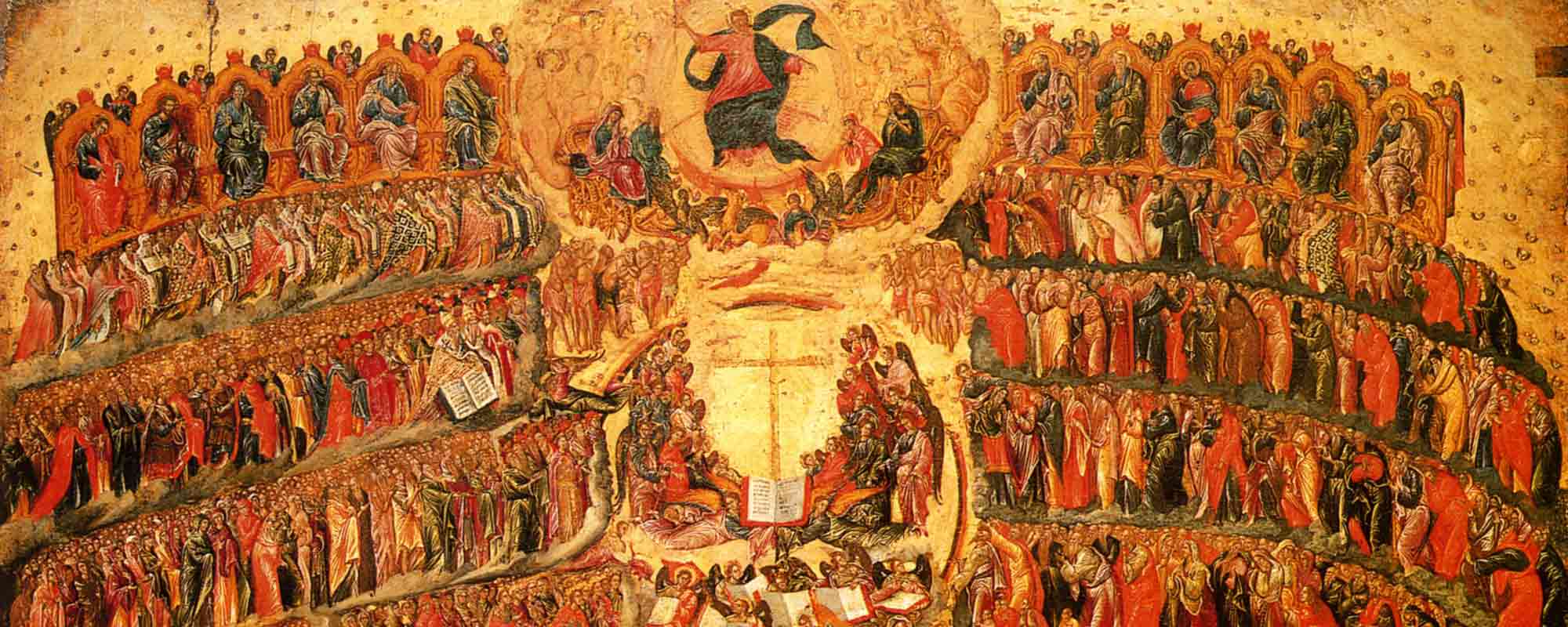
Two Sundays ago we entered the Triodion period, which prepares us for the Great Lent, which prepares us for Holy Week, which prepares us for the Great and Holy Pascha. With the Parable of the Publican and the Pharisee, the Church warned us not to present ourselves as righteous before God, but to humble ourselves before Him and rely on His mercy. With last Sunday’s Parable of the Prodigal Son, the Church again warns us not to be like the older son, but to display true repentance and rely on God’s mercy, love and forgiveness. Today we have a third warning: not to rely on our works, on ourselves, on our means, but to turn to God, now that there is time, to change our lives, and to display our love for our fellow human being, before it is too late.

The purpose of course of the Triodion as a whole is to prepare us for our point of death and for the Great Judgment. This thought should sober us up, and should remind us to watch and pray, to come to our senses, to repent, to change our lives, “while we have time” (Gal. 6:10), “making the most of the time, because the days are evil” (Eph. 5:16), as the Apostle Paul says. The saints meditated constantly upon death, in accordance with the biblical injunction: “In all you do, remember the end of your life, and then you will never sin” (Sir. 7:36). Unfortunately, we don’t want to hear about death, about judgment, about hell. We dismiss them, relying on the goodness of God, on His mercy and forgiveness. But is this wise and prudent?

apokatastasis ton panton
View more graphics like this here.

A heresy condemned by the Church, was that of the ἀποκατάστασς τῶν πάντων, the “final restoration of all things,” that is that everyone would be saved, when the “good Lord” would bring whatever suffering was inflicted on us to an end, so that eventually everyone would enjoy the blessings He has reserved for His elect. Not so, says the Church. Suffering is eternal; it has no end. It will go on and on, forever and ever, unto the interminable ages. No second chances, no going back, no room for repentance and forgiveness. “How can that be?” you ask. “How can good God do such a cruel thing? For a small sin, or for that matter even a great sin, that lasted a short while, to to suffer forever! Even we, as imperfect human beings, are more just than that. One’s suffering is proportionate to his crime. We cause our own punishment: life in prison, a life without end in hell, “the second death” (Rev. 20:6, 21:8)

Yet suffering will not be the same for everyone nor will everyone receive the same reward: “He will render to everyone according to his works” (Rom. 2:6), says the scripture. Elsewhere too the Apostle repeats: “For we must all appear before the judgment seat of Christ, so that each one may receive good or evil, according to what he has done in the body” (2 Cor. 5:10). The Lord also teaches us that not all the souls of the righteous will enjoy the same degree of blessedness: “In my Father’s house there are many rooms” (John 14:2). (Some will occupy the penthouse, others will be accommodated in a garden apartment – but everyone will be happy.) Also the Apostle Paul says: “Star differs from star in glory” (1 Cor. 15:41). Similarly the sinners will not suffer the same way, again according to the words of the Lord: “That servant who knew his master’s will, but did not make ready or act according to his will, shall receive a severe beating. But he who did not know, and did what deserved a beating, shall receive a light beating. Everyone to whom much is given, of him will much be required; and of him to whom men commit much they will demand the more” (Lk. 12:47-48). Also concerning the cities in which the Lord preached and which did not receive Him He said, “it will be more tolerable on the day of judgment” for the land of Tyre, Sidon and Sodom and Gomorrah than for them (Mt. 10:15, 11:21-24).

“The works of the flesh are plain: fornication, impurity, licentiousness, idolatry, sorcery, enmity, strife, jealousy, anger, selfishness, dissension, party spirit, envy, drunkenness, carousing, and the like. I warn you, as I warned you before, that those who do such things shall not inherit the Kingdom of God.”

Saint Paul’s letter to the Galatians 5:19-21.

Who will suffer and who will be rewarded? We’ve already heard St. Paul say that besides murderers and haters of God, many other sinners, including gossipers, deceitful, boastful and disobedient people, “deserve to die” and to be condemned. There are other such lists. In his First Letter to the Corinthians St. Paul says most emphatically: “Do you not know that the unrighteous will not inherit the Kingdom of God? Do not be deceived; neither fornicators, nor idolaters, nor adulterers, nor sexual perverts, nor thieves, nor the greedy, nor drunkards, nor revilers, nor robbers will inherit the Kingdom of God.” (1 Cor. 6:9-10). To the Galatians too he says: “The works of the flesh are plain: fornication, impurity, licentiousness, idolatry, sorcery, enmity, strife, jealousy, anger, selfishness, dissension, party spirit, envy, drunkenness, carousing, and the like. I warn you, as I warned you before, that those who do such things shall not inherit the Kingdom of God” (Gal. 5:19-21. Cf. Eph. 5:3-5, Col. 3:5-10). Also St. John the Theologian in the Book of Revelation writes: “But as for the cowardly, the faithless, the polluted, as for murderers, fornicators, sorcerers, idolaters, and all liars, their lot shall be in the lake that burns with fire and sulfur, which is the second death” (Rev. 21:8).

“But as for the cowardly, the faithless, the polluted, as for murderers, fornicators, sorcerers, idolaters, and all liars, their lot shall be in the lake that burns with fire and sulfur, which is the second death.”

Saint John the Theologian, Revelation 21:8

Now who are those who will inherit life eternal? The Lord said: “Every one who has left houses or brothers or sisters or father or mother or children or lands, for my name’s sake, will receive a hundredfold, and inherit eternal life” (Mt. 19:29), that is all those who renounced the world and followed the Lord. The Apostle Peter in his Second Letter also assures us: “His divine power has granted to us all things that pertain to life… by which He has granted to us His precious and very great promises…”, and then he tells us how to attain them: “Make every effort to supplement your faith with virtue, and virtue with knowledge, and knowledge with self-control, and self-control with steadfastness, and steadfastness with godliness, and godliness with brotherly affection, and brotherly affection with love… so there will be richly provided for you an entrance into the eternal Kingdom of our Lord and Savior Jesus Christ” (2 Pet. 1:5-11).

“Make every effort to supplement your faith with virtue, and virtue with knowledge, and knowledge with self-control, and self-control with steadfastness, and steadfastness with godliness, and godliness with brotherly affection, and brotherly affection with love… so there will be richly provided for you an entrance into the eternal Kingdom of our Lord and Savior Jesus Christ.”

Saint Peter, 2 Pet. 1:5-11

Where do we stand? Do we live a life worthy of reward or of suffering? Let me guess what our answers are to this question. Probably, “I’m not perfect, but nobody is”, or “I do my best”, or “Look, I’m not a criminal”, or “I wouldn’t think I deserve hell”, and the like. How do the Saints answer the same question? In the most characteristic hymn of the entire Triodion period, chanted at every Sunday Orthros Service, we chant: “As I ponder in my wretchedness the many evil things that I have done, I tremble for the fearful day of judgment. But trusting in Your merciful compassion, like David I cry to You: ‘Have mercy on me, O God, in Your great mercy.’” What a beautiful prayer, displaying the correct ethos of an Orthodox Christian. Here is another similar prayer from today’s Orthros Service: “O Lord, supreme in love, as I think upon Your fearful judgment seat and the day of Judgment, I tremble and I am full of fear, for I am accused by my own conscience. […] Therefore have mercy upon me before the end, and spare me, O most righteous Judge.” (Oikos)

Fr. E.H., Apokreo/97

GIVING WITNESS TO THE TRUE CHURCH

Orthodox Christians all over the world have received the unchanging Christian Faith, passed down from the Holy Apostles to their successors, and continue to practice it today in the One Holy Catholic and Apostolic Church – The Orthodox Church.
%%tb-image-alt-text%%

There is only one way to reach salvation and life eternal

A sermon for the Sunday of the Great Judgment

Are we taking our salvation for granted? Do we believe that we are saved or that salvation is easily achieved? Do we think that “worrying” about our salvation is a temptation, which we should rid ourselves from? Do we rely on God’s mercy, love and compassion, that surely He won’t let us go to Hell? (after all, we are not the world’s worst sinners…) Do we hope that we will “make it” to Paradise? That we will enjoy life eternal with the righteous? In order to answer these and other such questions let us examine briefly if our hope is well founded and what is life eternal. Let us start by examining what life eternal is.

What is life eternal?

What is life eternal? If you ask the question you are likely to hear: “And who came back from the other life to tell us what is like?” How we forget… Didn’t Somebody come back from death? Isn’t our faith based on this fact? But the point we want to make is that we are asking the wrong question, when we ask “What is life eternal?” We make the same mistake Pontius Pilate did, when he asked the Lord “What is truth?” In either case the question is not, What, but, Who. Because both truth and life are not abstract concepts, notions and ideas we invented and created by and for ourselves, but are embodied in the very person of Jesus Christ, Who is the Truth, the Way, the Life and Justice and Righteousness and Love. Eternal life is to know the One True God and His Only Begotten Son: “This is eternal life, that they know Thee the only true God, and Jesus Christ whom Thou hast sent” (John 17:3).

Knowledge of the One True God is life eternal. To know, in biblical language, means to have a profound and intimate relationship. Therefore when we say knowledge of God, we mean the union of man with Christ. Knowing Christ means to be in communion with Christ, which means to participate in the very life of Christ, Who is Himself the true life: “This (Jesus Christ, the Son of God) is the true God and eternal life” (1 John 5:20). This knowledge of the true God begins in this life. Writes St. Nicholas Cavasilas:

“The life in Christ originates in this life and arises from it. It is perfected, however, in the life to come, when we shall have reached the last day. It cannot attain perfection in men’s souls in this life, nor even in that which is to come without already having begun here” (The Life in Christ, 1,1, p. 43).

“To the extent, then, that we love God, God reveals Himself to us and communicates His divine energies to us, and thus we are known by Him. Conversely, he who does not love God, is not known by Him, and therefore, without God’s grace, he is utterly incapable to reach any true knowledge of God.”

What must I do to attain life eternal?

As we have pointed out, the knowledge the Lord speaks of, does not consist of being informed about God, of becoming familiar with facts relating to God, of becoming aware of what God is like. This knowledge is not intellectual, grasped by the mind alone, a comprehension reached through the application of our mental faculties; it is not our achievement, our accomplishment; it is not the knowledge which “puffs up” (1 Cor. 8:3). One does not “know” God through the intellect, but through love. Or, to be more precise, “if one loves God, he is known by Him” (1 Cor. 8:3). Notice he doesn’t say: “If one loves God, he knows God”, but “If one loves God, he is known by Him,” that is, God comes to his life and through the Holy Spirit infuses in him every knowledge by divine revelation: “God’s love has been poured into our hearts through the Holy Spirit which has been given to us” (Rom. 5:5), says St Paul. And St. John writes: “You have no need that any one should teach you; as His anointing teaches you about everything, and is true, and is no lie” (1 John 2:27). God, through His Holy Spirit, grants to loving hearts “to know the love of Christ which surpasses knowledge” (Eph. 3:19), responding to a heart which responds to His love, filling it “with all the fullness of God” (Eph. 3:19), as no human knowledge can ever accomplish. Let us also remember St. Paul’s words: even to have all “knowledge,” without love is not worth anything (cf. 1 Cor. 13:2).

To the extent, then, that we love God, God reveals Himself to us and communicates His divine energies to us, and thus we are known by Him. Conversely, he who does not love God, is not known by Him, and therefore, without God’s grace, he is utterly incapable to reach any true knowledge of God. That is why God will say to those who truly loved Him (as shown by their genuine love for their brothers and sisters): “Come”; but to those who did not truly love Him (as shown by their lack of genuine love for their brothers and sisters): “Depart.” The former will inherit eternal life; the latter eternal suffering.

“Not everyone who says to me, ‘Lord, Lord,’ shall enter the kingdom of heaven, but he who does the will of my Father who is in heaven.” (Mt. 7:21)

Let’s not deceive ourselves, my brothers and sisters: To confess God with our mouth is a God-given gift: “No one can profess Jesus to be Lord, except by the Holy Spirit” (1 Cor. 12:3). But, unlike what many would have us believe, such confession is not a panacea. Confessing the Lord is only a beginning, not an end, despite any scriptural evidence adduced to the contrary (Mt.10:32 – Lk. 12:8, Rom. 10:9, 1 John 4:15, etc.). What if the lips confess the Lord, but the deeds don’t show it? St. Paul speaks of such men who “profess to know God, but deny him by their deeds” (Tit. 1:16. Cf. also Hos. 5:4). The Lord Himself declared in no unclear terms: “Not everyone who says to me, ‘Lord, Lord,’ shall enter the kingdom of heaven, but he who does the will of my Father who is in heaven” (Mt. 7:21). Loving God is not demonstrated in words, but in actions: “For He will render to every man according to his works” (Rom. 2:6). And the beloved disciple confirms: “Little children, let us not love in word or speech, but in deed and in truth” (1 John 3:18). And God reveals: “I will give to each of you as your works deserve” (Rev. 2:23).

Is our hope to attain life eternal founded?

Our hope is based on our not having committed murder, extortion, rape, incest, robbery or any such terrible crime. Or perhaps on not having lied and cheated, spoken evil, and generally not having committed a sin. In today’s gospel passage the Lord makes it clear that our judgement will not be based upon what sins we did not commit, but to what extent we have demonstrated our love for God by imitating Him and by pouring out this love all around us.

“As long as you believe that you are “OK”, a “decent” person, a well-to-do individual, a “good” Christian, God’s grace is not with us!”

But don’t be deceived. No works save man. The Pharisee not only did not commit any evil deeds, but to the contrary he tithed his total income. The older brother in the Parable of the Prodigal Son, the “good guy” who followed all the commandments and obeyed God’s will, never having left his father’s House (the Church), was probably not saved because he displayed no signs of repentance and love. What about us? Are we better? Do we have perhaps what they lack? What is that? It’s called by a strange name: Humility; which is the state of someone who is humble, meek, unpretentious, lowly — before God!

Correct me if I’m wrong: Doesn’t the world, our society, our teachers, the psychologists tell us to be assertive and aggressive and self-confident and persistent and self-reliant and proud of ourselves, and having self-esteem — all in a “good” sense, of course? Don’t we strive for first place, for honors, for recognition, for gratification, for excellence, for self-respect — again, not in an arrogant or haughty way, but in an altogether “positive” way? It just shows you how God’s ways differ from the world’s ways…

There is only one way for us to reach salvation and life eternal: to repent, to humble ourselves, to declare our sinfulness, to cry Kyrie eleison, weeping over our sins. Then to come to Church, to let Christ’s blood circulate in our veins. For as long as we believe that we are “OK”, a “decent” person, a well-to-do individual, a “good” Christian, God’s grace is not with us! Have you ever heard a sermon and said to yourself: “Too bad those who should hear it are not around”? That means that you are comparing yourself to those you consider to be worse off than you. How then do you differ from the Pharisee of the Parable? “God, if You only knew how good I am… I give to Your Church money, labor, time… I’m not like the “others” who do not contribute much… God, I only wish everyone would be like me.” Thus we set ourselves as measures, as exemplars, as role-models, appropriating Christ, in whose image we were created and whose likeness we strive to achieve. The self-proclaimed righteous, all of the “good” Christians out there, are nothing less than idolaters! Their idol being their self.

Sometimes we are presumptuous. We think “God is great, God is merciful. He would not condemn us to hell. He wants everyone to be saved. We confess His Name, we try our best to do His will.” Listen to what St. Paul has to say to us: “Do you presume upon the riches of His kindness and forbearance and patience? Do you not know that God’s kindness is meant to lead you to repentance?” (Rom. 2:4). Thus we have come full circle, and from love we were lead back to repentance, because before putting on the roof we should lay the foundation. God is merciful, forgiving, good and loving. But He is also Just. If repentance did not get through to us from the parables of the Publican and the Pharisee and of the Prodigal Son, may it at least come through fear of the terrible Judgment that awaits us all. Remember: Contrary to common belief, life eternal does not start after death. Life eternal is not a condition beyond time. The life of the age to come begins here, from this life.

Let us ready ourselves for it, shall we?

Fr. E.H. / Apokreo (Meatfare) Sunday, 1991/96

GIVING WITNESS TO THE TRUE CHURCH

Orthodox Christians all over the world have received the unchanging Christian Faith, passed down from the Holy Apostles to their successors, and continue to practice it today in the One Holy Catholic and Apostolic Church – The Orthodox Church.
%%tb-image-alt-text%%

What is the correct mindset and attitude a Christian should have?

“As I ponder in my wretchedness
upon the many evil things that I have done,
I tremble for the fearful day of judgment.
But trusting in Your merciful compassion,
like David I cry to You:
Have mercy on me, O God, in Your great mercy.”

Thus goes a special hymn we chant during the Triodion period in the Orthros service, sorrowfully, in Tone Plagal of the Second (hear it chanted in the video to the right). Let us reflect on this short hymn, because it expresses admirably the ethos and phronema, the correct mindset and attitude a Christian should have, and it provides a beautiful commentary on the Gospel we hear on the Sunday before Great Lent, which gave the name to this Sunday: “Judgment Sunday.”

Let us examine our conscience

In the first place we are moved, together with the sacred hymnographer, to take a retrospective look into our lives, and ponder upon our actions. Do we ever do that, my dear brothers and sisters? If we do, how often and how thoroughly? And what do we do as a result? Unfortunately, by dear Christians, my experience tells me that we are not accustomed of examining our conscience, and when we do, we go about it in a very superficial way, and very quickly we exonerate ourselves of any wrongdoing. Even on our death bed, in searching our lives, all we find is that we have lived good lives, not having murdered or robbed anyone.

It is precisely because of such woefully imperfect, totally inadequate, and most superficial “examination of conscience” we make, that the Lord brings before us today the scene of the Great and Fearful Judgment. Notice well, dear Christians: The Lord will not ask us, “Have you murdered anyone? Have you robbed anyone?” but instead He will reveal to us our spiritual poverty, showing us that we have lived a selfish life, totally oblivious to the plight of our fellow human being.

The hymnographer trembles when he ponders upon his life, which he calls wretched, because he discovers “the many evil things” he has done–not one or two, but many evil things. How come we don’t discover these things in our lives? Last Monday, in our Bible Study class, we said that God gave us a conscience, which was compared to a knife: We can keep it razor sharp, or we can let it rust and become dull. So with our conscience: we can let it become dull, or we can keep it sharp at all times, utilizing this useful gift of God. Our conscience is like a muscle–if it is not used, it atrophies, it loses its flexibility, and it’s almost useless. We have the responsibility to maintain our conscience sharp. And just because we don’t feel guilty, it does not mean we are not going to be found guilty at the Great Judgment of Christ.

So my dear Christians, we need to examine our conscience and to accuse ourselves of any wrongdoing, as the prodigal Son did, who said to his father, “I have sinned against heaven and before you” (Lk. 15:21); and as prophet-king David did, who, after sinning gravely, said, “Have mercy on me, O God… blot out my transgressions. Wash me thoroughly from my iniquity, and cleanse me from my sin! For I know my transgressions, and my sin is ever before me” (Ps. 51:1.2-3). Let us not blaspheme, by saying we have no sins. Let us humble ourselves, discover our many iniquities, and cry out to the Lord, “Enter not into judgment with Your servant; for no man living is righteous before You” (Ps. 143:2).

How we will be judged

“My beloved brothers, abandoning everything let us run naked and, approaching Christ the Master, let us fall down and weep before His goodness, so that He, indeed, having seen our faith and humility, may… make us worthy celebrants of the bridal chamber of heaven.”

St. Symeon the New Theologian, Ethical Discourses, p. 152.

Let us comprehend this well, that our defense is not going to be “I have not bothered anyone, I did my business,” but rather, Have I opened the door of my heart to my neighbor, or have I shut it, as I have shut the door of your house, justifying my action with, “Let someone else take care of my neighbor; let the government do something for him; I can’t.” I visited this woman, who is sick. No one goes to visit her. No one knocks on her door to ask her, “How are you? Are you all right? We have not seen you lately. I’ve been thinking of you.” Where is our Christian charity and compassion? How much effort does it take? But this does not seem to bother us. “Eh, I mind my own business,” we say, as if this were the ultimate virtue. The ultimate “business” is to be of service to those in need.

Here then is the need to review our life and make whatever adjustments are necessary. Let me share with you this thought. I think that for us Christians, Judgment is not going to be on what we have done in life, good or bad–this is going to be the case for the non-Christians. For us Christians the Judgment is going to be a personal accounting for what we have done in return for what Christ has done for us. For those who have not known Christ, they will be judged based on whether they have lived according to their conscience, whether they have done right or wrong. For us, however, who call ourselves Christians, followers of Christ, much more will be demanded! It is going to be a matter of whether we have loved Christ with the same love He has loved us, whether we have multiplied the gifts He has bestowed upon us and has made available to us through His holy Church, and of whether we lived by the promises we made when we were baptized.

For us Christians the Judgment is going to be a personal accounting for what we have done in return for what Christ has done for us.

Let us make this point a little more explicit and obvious. If we think we can lull our conscience with the familiar line, “I haven’t killed anyone, I haven’t robbed anyone,” let us think again. The question asked of us is going to be, “Have you loved your fellow human being to death? Have you withstood anything on account of the love you have for your fellow human being?” When her child is sick the mother does not sleep; she spends all her time by his bed side, suffering with her child, feeling great pain for her child’s pain. The question that will be asked of us Christians is going to be, “Did you suffer for your suffering brother and sister? Have you done all you could in your power to alleviate their pain and suffering? Have you set aside some of your comfort, your leisure, your enjoyment, your good time, because the thought of your suffering brother and sister was too great and intense to make you relax and to take it easy?” If yes, blessed are you, because you will escape judgment.

The Lord’s look

If you think this is something I have dreamt up, listen to the words of St. John Chrysostom:

“At the Second Coming, those sweetest eyes, full of untold love and compassion and tenderness will stare at us; they will look at us with a complaint, and then we will not know where we are going to go to hide.”

This silent look will penetrate every fiber of our being, this sorrowful look will be intolerable to bear, this look will wound us more than a thousand swords, which will cause us more pain than an infectious wound. Do you want to know something? Perhaps this look of Christ is what hell is: The pain of not having sought Him, of not having loved neither Him nor our fellow human being, for whom He also sacrificed Himself.

Christ will appear before us, my friends, in all His glory, enveloped in His uncreated divine light. If we have not lived in His light, if we have spent our life in the darkness, away from Him, from His knowledge, from His love, then His light will blind us, as the strong sun light will blind someone who emerges from a dark cave, after spending a long time in it. Says the holy Evangelist John: “And this is the judgment, that the light has come into the world, and men loved darkness rather than light, because their deeds were evil” (John 3:19). So who is not going to be judged? Those who have loved much. They will escape judgment, condemnation, punishment. God’s love was given to us freely, plentifully, undeservedly. They who have responded to His love will enjoy the bliss of His love for all eternity.

On the night in which the Son of God was betrayed by Judas, he was also betrayed by his chief disciple, Peter, “Rocky.” He reneged on his Master, not once, but three times. The third time Peter was not far away from the Master. As Peter himself later narrated this story to his disciple Luke the Evangelist, “And immediately, while he was still speaking [saying that he did not know the Lord], the cock crowed. And the Lord turned and looked at Peter” (Luke 22:60-61). That silent look of the Master brought the denier to his knees, and make him cry bitterly for his pusillanimity, his weakness, his faintheartedness, and gave him the strength he needed to escape from his cowardice, his selfishness, the fear of his life, and strengthened him to eventually embrace death for the love of his Master Jesus.

My dear brothers and sisters: Let us not wait until the Lord casts His sorrowful eye at us at His Second Coming. For by then it will be too late. Let us then prepare ourselves from now, led to His love, to the love for our fellow human being, to the forgiveness and compassion for our suffering brother and sister, to a deep repentance, to a life of adoration, praise, and glorification of the Savior. Amen.

Fr. E.H./2000

GIVING WITNESS TO THE TRUE CHURCH

Orthodox Christians all over the world have received the unchanging Christian Faith, passed down from the Holy Apostles to their successors, and continue to practice it today in the One Holy Catholic and Apostolic Church – The Orthodox Church.
%%tb-image-alt-text%%

“Judge not, that you be not judged”

What does “judge not” mean? “Judge not, that you be not judged.” (Mt. 7:1) Judge, in this instance, means to condemn. This is obvious from the second part, “that you be not judged,” that is, you are not going to be condemned at the Great Judgment. Another biblical example we have when the scripture says, “For God will judge the immoral and adulterous” (Heb. 13:4). Obviously it does not mean that God will decide whether they deserve punishment or not; it means that God will condemn them. The Lord therefore says, Do not condemn, so that you won’t be condemned either. This is made even clearer by St. Luke, who immediately after saying “Judge not, and you will not be judged,” he adds “condemn not, and you will not be condemned.” (Luke 6:37)

If then we don’t want to be condemned at the Great Judgment that will take place at the Second Coming of the Lord, we must be careful not to condemn others. It is not our business to pass judgment. Says St. James:

“Do not speak evil against one another, brethren. He that speaks evil against a brother or judges his brother, speaks evil against the law and judges the law. But if you judge the law, you are not a doer of the law but a judge. There is one lawgiver and judge, he who is able to save and to destroy. But who are you that you judge your neighbor?” (James 4:11-12)

So don’t judge and you won’t be judged. It sounds simple, but it requires a lot of struggle, a lot of discipline, a lot of self control. I’ll tell you a story that reveals the power of not passing judgment on others.

There was a monk who was lazy, careless, disinclined to prayer, but throughout his entire life he had never judged anyone. And as he lay dying, he was full of joy. The brethren asked him how he could die so joyfully with all his sins, and he replied, “I have just seen the angels, and they showed me a page with all my many sins. I said to them: “The Lord said, ’Judge not, that you be not judged.’ I have never judged anyone and I hope in the mercy of God, that He will not judge me.” And the angels tore up the sheet of paper.’ Hearing this, the monks wondered at it and learned from it. 0

We have no business judging others. St. Paul writes:

“You have no excuse, O man, whoever you are, when you judge another; for in passing judgment upon him you condemn yourself, because you, the judge, are doing the very same things.” (Rom. 2:1) 1

Indeed how can we criticize others for their perceived faults when we have plenty of our own, and perhaps bigger ones? How can we be bothered by the splinter in our brother’s eye, when the log in our own eye doesn’t seem to bother us? (Cf. Mt. 7:3) We are all sinners. Therefore we cannot condemn anyone about anything, since we too transgress God’s law.

We are not supposed to judge others. “Who are you to pass judgment on the servant of another?” says elsewhere St. Paul. “It is before his own master that he stands or falls. And he will be upheld, for the Master is able to make him stand.” (Rom. 14:4) And again he repeats:

“Why do you pass judgment on your brother? Or you, why do you despise your brother? For we shall all stand before the judgment seat of God… Then let us no more pass judgment on one another, but rather decide never to put a stumbling block or hindrance in the way of a brother.” (Rom. 14:10.13)

Let us reflect on these things, my brothers and sisters:

  • Are we perhaps too prone to criticize others?
  • Are we too preoccupied with others’ faults, to the point of overlooking our own big shortcomings?
  • Do we find ourselves rationalizing our sins, by pointing out the same or worse mistakes in others?

When we feel like criticizing others, let us reflect on our own faults; this way we may find we don’t have very much to say. Keep also this in mind: For every little thing that you condemn your brother, you yourself will be judged and condemned at the Great Judgment. Not only we should not be critical of others but we should cover their faults and be understanding, loving and compassionate towards everyone.

Mercy triumphs over judgment

Whether we speak or act we must always remember that one day we will all be judged: “So speak and so act as those who are to be judged,” says St. James (James 2:12). In so doing we should also keep in mind what he further adds: “For judgment is without mercy to one who has shown no mercy; yet mercy triumphs over judgment.” (James 2:13) Mercy and compassion have nothing to fear of judgment! “Blessed are the merciful, for they shall obtain mercy,” says the Lord (Mt. 5:7). Prince Myskin, in Dostoyevsky’s The Idiot, says,

“Compassion is the highest and perhaps the only law of existence of the entire humanity.” 2

I was talking the other day to someone who sees a psychologist on a regular basis.

“Don’t these shrinks keep you at a distance?” I asked. “They don’t believe in sympathy, but in the detached empathy.”

“Not this particular psychologist I see,” he said. “She is caring and compassionate. And that means a great deal to me.”

“Yes,” I reflected out loud, “Here is the failure of the established Church to reach out to those in need. We create a void, and we leave it up to the shrinks, to AA’s, and other secular support groups to fill it. And, to our shame, they do an admirable job.”

I hear the ominous words of the Lord, “Unless your righteousness exceeds that of the scribes and Pharisees, you will never enter the kingdom of heaven.” (Mt. 5:20) What difference do we Orthodox make in our society? What relief do we bring to wounded and suffering humanity?

The Law of Love

We should apply for others not judgment, but mercy and compassion, as our Heavenly Father does, who rains on just and unjust. Think of this, my brothers and sisters: We speak of God’s justice and God’s righteous judgment, yet God transcends justice as we understand it and apply it. St. Isaac the Syrian writes:

“Do not presume to call God just, for what sort of justice is this: we sinned, yet He gave up His only-begotten Son on the Cross?” 3

God has only one law: the law of love. Let’s apply then this “law,” and this law only, among ourselves.

Think of this: We forgive our children no matter what they do, because we love them. God loves us! He loves us to death. Actually, “God so loved the world, that He gave His only Son, that whoever believes in Him should not perish but have eternal life.” (John 3:16) What He wants from us is to love Him in return! And that’s not selfish on part of God! Returning His love means imitating Him, becoming like Him, having His life, attaining salvation and life eternal. Our sins are forgiven us in the act of loving : “Her sins are forgiven,” said the Lord of the sinful woman, “because she loved much” (Lk. 7:47). St. Peter, who was an eye-witness to the episode, comments: “Love covers a multitude of sins” (1 Pet. 4:8) Clearly, then, this is the path for us to tred upon.

You may ask: What does the subject of love have to do with God’s judgment? Everything. The beloved disciple comments: “In this is love perfected with us, that we may have confidence for the day of judgment, because… there is no fear in love, but perfect love casts out fear.” (1 John 4:17-18) St. Anthony the Great said:

“I no longer fear God, but I love Him.”

Of course we are not presumptuous of having St. Anthony’s love, and the following story should make us reflect somberly on our place. I preface it by saying that the story I will now relate to you is extraordinary and hard, if not impossible to comprehend, it is a story that tests our faith to its limit.

“St. Anthony prayed the Lord to show him to what measure he had attained. And the answer was, that he had not reached the standard of a certain shoemaker in Alexandria. St. Anthony made his way to the man and asked him how he lived. The man replied that he gave a third of his earnings to the church, a third to the poor, and kept the rest for his own needs. St. Anthony, who had himself given up all he possessed and lived in the desert in greater poverty than the shoemaker, found nothing extraordinary in this. It was not here that he excelled. St. Anthony said to him, ‘The Lord sent me to you to see how you live.’ Then the humble working-man, who looked up to St. Anthony and was dismayed at his words, answered, ‘I don’t do anything special. Only, while I am working I look at passers-by and think, ‘They’ll all be saved, only I shall perish for my many sins.’” 4

Archimandrite Sophrony, who relates this episode, comments:

“Anthony, sent by God to learn of the shoemaker; Anthony, prepared by long and extraordinarily arduous ascetic struggle (that had amazed all Egypt) to grasp the real meaning of what the shoemaker said, sensed the force of his words and realized that he had not attained to the stature of the man.” 5

Then he goes on to relate the experience of his elder, St. Silouan the Athonite, who while in prayer, heard within him the words

“Keep your mind in Hell, and do not despair.”

Yes, suffer the torments of hell, as not deserving anything better. He also quotes from the Desert Fathers the story of St. Pimen the Great, who used to say to his disciples,

“Believe me, my children, where Satan is, there shall I be cast also.” (p. 211)

Tatiana Goritcheva also relates that she heard a woman’s prayer in church. This Russian woman was standing behind a big column and was repeating aloud over and over the words, “Lord, keep a small corner in hell for me.” 6 Elsewhere she relates the following episode. Once a woman approached a great staretz, and complained to him that another woman was trying to perform magic on her. The elder listened to her attentively, then said: “I’ve lived seventy years in this world, and I have not met a single evil person, except myself.” 7 This, my brothers and sisters, is a hard lesson, but there is only one way to avoid God’s judgment, and that is to condemn one’s self constantly before God.

It is only after we confess to the Lord that we are the chief sinners, that we approach the communion cup to be united with Him. Expression of our unworthiness is a precondition of our union with God. We don’t present ourselves as righteous, as worthy, but as the least, the most unworthy. This is different from considering ourselves worthless, as we said last Sunday. Christ gave His life for us; so we are worth a great price. But do we live up to that price? If Christ’s blood has not purified us, if we continue to live in sin, aren’t we the most wretched of sinners? Yet we don’t despair, because we have faith in Him who redeemed us and we hope and pray that we won’t be condemned.

He who believes is not condemned

He who believes in God is not condemned,” says St. John, the beloved disciple (John 3:18). “Truly, truly, I say to you, he who hears my word and believes Him who sent me, has eternal life; he does not come into judgment, but has passed from death to life,” says the Lord (John 5:24). So is this evidence of instant salvation, or guaranteed salvation, of the “I am saved” type of belief? Hardly. To the “I am saved” types let the following passage from the First Letter of St. Paul to the Corinthians suffice: “I am not aware of anything against myself, but I am not thereby acquitted. It is the Lord who judges me. Therefore do not pronounce judgment before the time.” (1 Cor. 4:4-5) The “time” is the time of death. Let’s not absolve ourselves. Let’s follow the example of the Saints who teach us with their word and deed that we must always have the fear of God in us. The example of Abba Agathon is one we should heed.

“This man struggled to obey all the commandments. If the boat made a stop, he was the first to grab the oar; when the brothers visited him, he stopped the prayer instantly and set table for them, because he was full of love.

When he was close to death, he remained motionless for three days, with his eyes open. Then the brothers shook him, and asked, ‘Abba Agathon, where are you?’ And he answered them, ‘I stand before the Judgment Seat of God.’ “And you are afraid, Father?’ they said. “Until now,” he replied, “I spent my energies to keep the commandments of God. But I am a mere man. How do I know whether my life pleased God?’ Then the brothers said, ‘Aren’t you sure that your life pleased God?’ And the Elder answered, ‘I won’t take it for granted, until I meet God. Because the criteria of God are different than the criteria of men.’ And as they were about to ask him another question, he told them, ‘Practice love; and do not talk to me any more, because I have work to do.’ And thus he ended his course joyfully.” 8

To escape God’s judgment let us not condemn our brothers and sisters, but let us practice brotherly love and compassion. Amen.

Fr. E.H./98

  1. From the Prologue, March 30
  2. …and read the rest of the chapter, to v. 24)
  3. Quoted by Tatiana Goritcheva, The Madness to be Christian, p. 107.
  4. Source unknown.
  5. The story is from the Gerontikon. See it also in vol. 3 of Χαρίσματα καὶ Χαρισματοῦχοι, pp. 242-243.
  6. Saint Silouan the Athonite, p. 211.
  7. It is Dangerous to Speak of God, page unknown.
  8. How I Found God in the Soviet Union, p. 58.
  9. From the Gerontikon.
Item added to cart.
0 items - 0,00 $