Articles for tag: Q&A

GIVING WITNESS TO THE TRUE CHURCH

Orthodox Christians all over the world have received the unchanging Christian Faith, passed down from the Holy Apostles to their successors, and continue to practice it today in the One Holy Catholic and Apostolic Church – The Orthodox Church.
%%tb-image-alt-text%%

Why a Crucified Messiah? by Fr. Thomas Hopko – Part 1
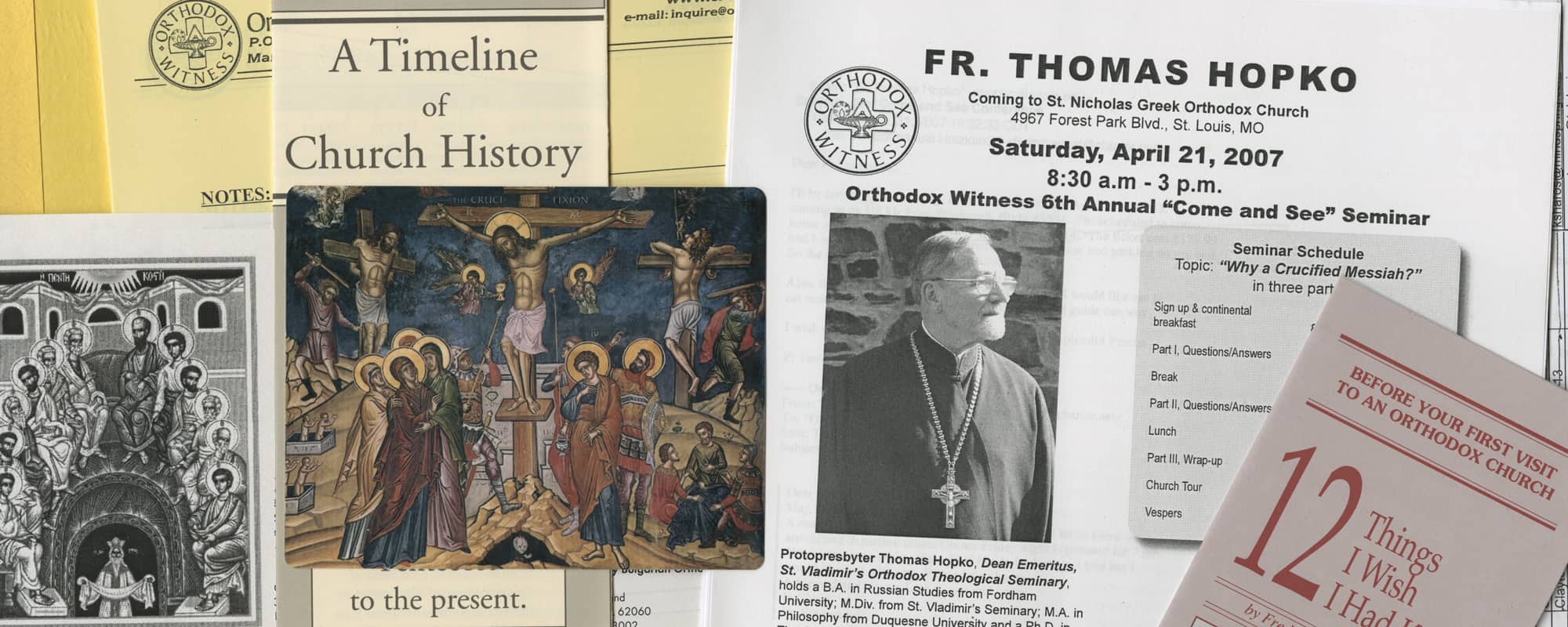
Why did the Messiah, the Savior of the world, have to necessarily die an unnatural death by being murdered?

Fr. Thomas Hopko gave the talk, Why a Crucified Messiah, at the 2007 “Come and See” seminar in St. Louis Missouri. The Seminar, the 6th organized by Orthodox Witness, was held at St. Nicholas Greek Orthodox Church in St. Louis Missouri. The “Come and See” seminars were organized to invite our community to learn more about the teachings of the Orthodox Church from high profile Orthodox converts and speakers.

Fr. Hopko delivered two talks at the 2007 seminar. In this post, we present the first of his two talks: “Why a Crucified Messiah?” [Total time: 1 hour, 15 minutes]

Download an mp3 of this talk, for free, HERE.


Also: Listen to Fr. Hopko’s 3 minute review of Fr. Emmanuel’s book, The Heavenly Banquet: Understanding the Divine Liturgy:

Read a transcript here, and buy The Heavenly Banquet here.

Photo of author
The Orthodox Witness website is published by Anthony Hatzidakis.

GIVING WITNESS TO THE TRUE CHURCH

Orthodox Christians all over the world have received the unchanging Christian Faith, passed down from the Holy Apostles to their successors, and continue to practice it today in the One Holy Catholic and Apostolic Church – The Orthodox Church.
%%tb-image-alt-text%%

Psalm 129:4: “Christ will cut their necks” – an Interpretation

cut-in-pieces-orthodox-witness

It was eight weeks ago. My son came over to me and said, “Dad, I can’t chant this” (the second Antiphon of the Anavathmoi of Tone Plagal of the Fourth—8th Tone for the non-Greek Orthodox). I remember it was eight weeks ago because, as every chanter knows, there are eight Tones, so by chanting them in sequence we return to the same Tone every eight weeks. So, how does the Antiphon go in the rendering of Fr. Seraphim Dedes? “Let the haters of Zion become as the grass is before it is plucked up. For Christ will also cut their necks with the cutting sword of torments.”

I have to admit, at first reading the verse sounds horrible. It presents our good Lord as behaving worse than an ISIS terrorist: beheading His enemies and tormenting them in the process (definitely, against the Geneva Convention). What I told my son is that the Church does two things: first, she identifies Yahweh of the Old Testament with Jesus Christ; and second, she gives to those instances of violence a “spiritual” meaning.1 Whereas the Jews understood such expressions in a physical and historical setting, the Church views them in the timeless, eternal Kingdom of God, where the sinners will suffer for obstinately opposing the Christ of God. They inflict the punishment upon themselves, for they refuse to acknowledge their Redeemer.

Well, eight weeks later, not being satisfied with my own explanation, I gave the verse a more careful look. Here are my findings:

The Antiphon draws from Psalm 129:4 (128:4 according to the LXX), which reads, “The righteous Lord cut in pieces the necks of sinners” (The Orthodox Study Bible).2 But if we take a look at the various translations of the passage into English that are based on the original Hebrew (Masoretic) text a quite different meaning emerges. Thus the RSV renders it, “The LORD is righteous; he has cut the cords of the wicked.” In fact, ALL of the translations that I consulted essentially agree with this translation.

The contested word in the Septuagint version is αὐχένας, which means necks, whereas the Masoretic word is עֲב֣וֹת (‘ă·ḇōṯ), which means cords or ropes. So what is the meaning of Psalm 129, verse 4? Let us follow the verse in its context:

“Israel, tell us how your enemies have persecuted you ever since you were young.” “Ever since I was young, my enemies have persecuted me cruelly, but they have not overcome me. They cut deep wounds in my back and made it like a plowed field. But the LORD, the righteous one, has freed me from slavery.

As we see, the Good News Translation we have used makes the meaning quite plain. Israel, which is speaking here, has obtained release from its oppressors thanks to God, as the oxen fastened to the plow are freed when the cords that keep them tied to the plough are cut loose.3 God’s Word Translation marvelously explicates the meaning, while remaining faithful to the original: “The LORD is righteous. He has cut me loose from the ropes that wicked people tied around me.”

No one is just before the Lord. He alone is righteous and just. Because of our sins, the righteous Lord allows suffering and afflictions to befall us to help us to remember Him and turn to Him, and live. He is always merciful and compassionate, and comes to our rescue, to deliver us, because He will not test us more than we can handle. Thus after we had our measure of suffering, which is meant to humble us and to make us call upon Him, He comes and cuts the ropes with which our enemies (that is, our passions we cannot control and the devil that tempts us) entangle us, and keep us bound to sin—and frees us from their servitude.

Of course, the scripture is not limited to its historical setting. Beyond earthly Israel and earthly Jerusalem, its enemies and all the temporal vicissitudes to which we are subject, is Christ’s holy Church, against whom the powers of death shall not prevail (see Mt. 16:18). God will deliver His elect from the oppression and tyranny of the devil, and will set His people free from suffering and death. Interestingly, I. Kolitsara’s paraphrase into Modern Greek renders the line as follows: “[Our enemies] sat tyrannically over us, the impious idolatrous races pounded upon our backs, and for a long time they prolonged their iniquity. But the righteous Lord cut to pieces and humbled the prideful necks of the tyrant sinners.” This interpretation keeps the historical setting of an action that took place in the past, but with the words “humbled” and “prideful” understands it in an allegorical sense. This is also the interpretation of St. Augustine: “all are sinners and…all must fear the sword that hangs above their neck…but [only] proud sinners were meant to be understood, [as] all proud men carry lofty necks” (ad locum, NPNF-1, pp. 612).

This, then, seems to me, to be the meaning that comes through the original text. Although the Fathers in their writings as well as the hymnographer who composed the Antiphons had before them a translation that had misunderstood one Hebrew word, which means cords or ropes, and not necks, they did their best to give it an interpretation that made some sense. Thus St. Nikodemos the Hagiorite writes: “Christ will cut their necks with the sword of divine justice and with the cutting of torments, both eternal and temporal. For with such the Lord disciplines them with illnesses, suffering and misfortunes. By necks he means enigmatically haughtiness and pride, because the proud lift up their necks high…If you don’t walk humbly, but raise your necks high and your eyes and your head, most assuredly Christ our Master will cut your necks with the everlasting torments of hell.” (Nea Klimax, pp. 299-300)

Admirable as the patristic commentary is, I would like us to return to the original meaning, which happens to say the exact opposite of what the Septuagint text says. Far from cutting our necks, Christ cuts the ropes that wicked people tie around us, the noose that keeps us slaves to sin, Satan and death, and frees us from their yoke granting us life—His everlasting life.

  • Another similar example is offered by the haunting Doxastikon of Holy Thursday’s Lauds: “They stripped Me of My garments and put upon Me a scarlet robe. They set a crown of thorns upon My head and put a reed into My right hand, so that I might smash them like a potter’s vessel.” In these hymns our “meek and humble” (Mt. 11:29) Lord appears violent.
  • Sir Lancelot C. L. Brenton’s translation from the Septuagint is similar: “The righteous Lord has cut asunder the necks of sinners.”
  • The same image is conveyed in Ps. 124:7, where we read, “We have escaped as a bird from the snare of the fowlers; the snare is broken and we have escaped” (RSV). Far from yoking us with commandments we cannot keep, the Lord came “to loose the bonds of wickedness, to undo the thongs of the yoke, to let the oppressed go free, and to break every yoke” (Is. 58:6).

GIVING WITNESS TO THE TRUE CHURCH

Orthodox Christians all over the world have received the unchanging Christian Faith, passed down from the Holy Apostles to their successors, and continue to practice it today in the One Holy Catholic and Apostolic Church – The Orthodox Church.
%%tb-image-alt-text%%

What is Orthodox Fundamentalism?

orthodox fundamentalism

Orthodox Fundamentalism? It conjures up sights of militants and extremists. Yet, we are told that Orthodoxy is not immune to this malady that shows its ugly face in every religion, even in atheism. Sometimes the stigma of fundamentalism is ascribed to theologians who faithfully follow the Fathers and abide by the Canons of the Church. A case in point is an article I would like to address.

What are the characteristics of an Orthodox fundamentalist?

  • Typically, fundamentalists view the Bible, or any other book, as the literal word of God.1
  • In its extreme form fundamentalism is fanaticism.
  • Nearly all Old Calendarists are fundamentalists.
  • Most fundamentalists are also fanatics.
  • Separating from the Church on account of the change in the calendar is an extreme form of fundamentalism.
  • Fundamentalists label the New Calendar Orthodox “modernists.”
  • Fundamentalism is encountered mostly in monasteries, but it is most disturbing when it is encountered among the clergy and laity living in the world, who try to imitate the monastic lifestyle.

On January 29, 2015, the Greek Orthodox Archdiocese of America posted an article on its blog2 by Prof. George Demacopoulos3 with the title “Orthodox Fundamentalism.” The article went viral and was also carried by the blog of the Order of St. Andrew the Apostle (2/4/15). As pointed out in his article, aspects of Orthodox fundamentalism abound around us – both in the old continent and in the new World – particularly manifested in biblical literalism and pietism. However, the author labels other legitimate and traditional Orthodox beliefs and practices as fundamentalist, calling them “slavish adherence to a fossilized set of propositions.”

Far from being “used in self-promotion”, as he says, we are all called to follow the teachings and the way of life of the God-bearing Fathers.

Orthodox Fundamentalists?

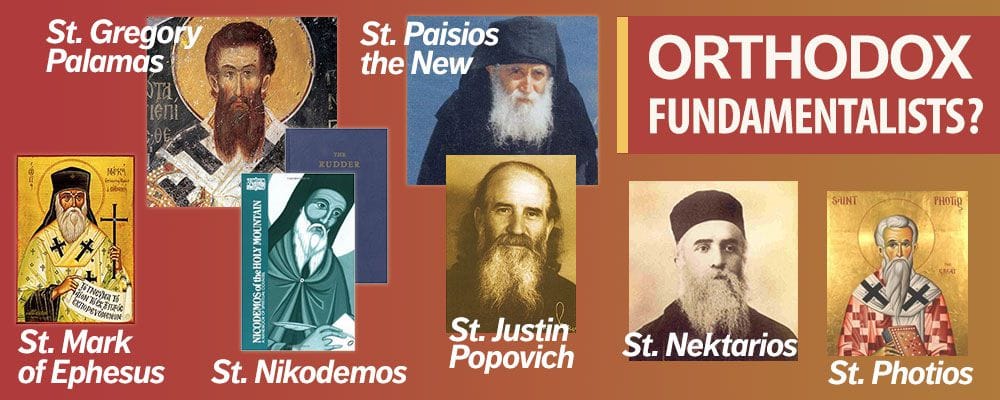
Demacopoulos inveighs against “so many [unnamed] Orthodox clerics and monks” who “have made public statements that reflect a fundamentalist approach to the Church Fathers,” called by him “extremists” and “radical opportunists.” Who are they? What statements have they made that deserve such epithets? It seems that their fault is that they adhere strictly to the teachings of the Fathers and the Canons of the Church. According to the author’s thinking we should classify the Fathers themselves as fundamentalist, among them St. Photios, St. Mark Evgenikos, St. Gregory Palamas, St. Nikodemos, St. Nektarios and more recently St. Justin Popović and St. Paisios. Certainly in his list belong Protopresbyters George Metallinos, Theodoros Zeses, Vasileios Voloudakis, and Metropolitans Hierotheos of Nafpaktos and Seraphim of Piraeus. Far from being fundamentalist, they express the correct faith, ethos and phronema of the Orthodox Church. The obvious question is, who are the author’s models among the Saints? Could he find even one that espoused what he does?

The Fathers were/are not the “intellectuals of their age,” as the author states, succeeded or rather superseded by the intellectuals of this New Age—presumably the academic scholars. The Fathers expressed their own experiences, having already reached theosis, which is the knowledge of God. These are the words of a contemporary Father, St. Paisios:

Theology is the word of God that is comprehended by pure, humble and spiritually reborn souls. It is not the beautiful words of the mind which are formed with philological artistry and which are expressed with the juridical or worldly spirit…Theology that is taught as a [worldly] science usually examines things historically and consequently understands things externally. Because patristic asceticism and inner experience are absent, this theology is full of doubts and questions. With his mind man is not able to comprehend the divine energies unless he first struggles ascetically to live these energies, so that the grace of God might work within him.

The Fathers do not disagree among themselves, as the author, following the “post-patristic” theologians, attempts to prove (needless to say, without succeeding), but expand, enrich, and deepen upon the teachings of the Fathers that preceded them, as they address, with the grace of the Holy Spirit, new problems that arise. They build upon each other the edifice of the Church. “To refuse to follow the Fathers, not holding their declaration of more authority than one’s own opinion, is conduct worthy of blame, as being brimful of self-sufficiency,” says a great Father of the Church.4 The Church calls the Fathers “the precise custodians of the Apostolic Traditions.”5

Fighting the Fathers

Theology is the word of God that is comprehended by pure, humble and spiritually reborn souls. It is not the beautiful words of the mind which are formed with philological artistry and which are expressed with the juridical or worldly spirit…

Saint Paisios the New

The progressive synchretist and ecumenist professors characterize the attachment to the patristic methodology of defending the Orthodox Faith and attacking and refuting the heresies as fundamentalist, they call the attachment to the Canons of the Church as legalism, the faithful adherence to the Christian ethics as pietism, and the checking of deviations from the pulpit as expressions of hate. This so-called post-patristic theology, far from being a continuation of the theology of the Fathers, constitutes a distortion of their teachings and a radical departure from their witness of the true faith in word and action. It constitutes a resurgence of the rationalist approach to the truth of Barlaamism condemned by the Palamite synods.6

The position taken in this article reflects the post-patristic and deconstructionist spirit that permeates the Theological Academy of Volos (which carried his article, translated by its director) with which the Center co-founded by the author collaborates, which vehemently fights against what was and the way it was “handed down” to us by the Fathers.

We ask:

  • What does Volos and its adherents have to say about the “fundamentalist” Creed and the “fundamentalist” Canons that the “fundamentalist” Fathers have passed on to us?
  • What of our “fundamentalist” dogmas, our “fundamentalist” Divine Liturgy, our “fundamentalist” Bible, our “fundamentalist” hymnology, our “fundamentalist” mysteries (like baptism and communion), and our “fundamentalist” morality?
  • Why reinterpret the Fathers and not reinterpret the antiquated “fundamentalist” faith of the “fundamentalist” Church founded by “fundamentalist” Christ?
  • Why stick to an exclusivist (“fundamentalist”) religion?
  • Why not start afresh with a contemporary expression of the faith? But…that’s what they propose! Unless they shout loud and clear the “fundamentalist” anathemas of the Church on the Sunday of Orthodoxy they have no place in Her.

Keeping the Fundamentals

In the end I would say that perhaps the Orthodox Church has remained “fundamentalist” in the original sense this word had when it was coined by Curtis Lee Laws, the editor of the Northern Baptist newspaper The Watchman-Examiner in 1920, who wrote, “We suggest that those who still cling to the great fundamentals and who mean to do battle royal for the fundamentals shall be called ‘Fundamentalists.’”7

  1. As it is stated succinctly by Cecil McGarry, S.J., “Christian fundamentalism sees the Bible as an encoded message from God, inerrant, infallible, never to be questioned. Its only meaning is the literal meaning of the words. The Bible alone is sufficient and adequate to guide us in all the problems of life, especially religious ones. The only adequate response is absolute and unquestioning obedience to God who is the author of the Bible.” (“A Thin Line Between Fundamentalism and Fanaticism,” Social and Religious Concerns, Ch. 43: 325-335, p. 325.
  2. http://blogs.goarch.org/blog/-/blogs/orthodox-fundamentalism
  3. Prof. George Demacopoulos is Director and Co-Founder of Orthodox Christian Studies Center together with Prof. Aristotle Papanikolaou, with whom he teaches theology at Fordham University, a Jesuit School. He also happens to be an “Archon Didaskalos Tou Genous” of the Order of St. Andrew of the Ecumenical Patriarchate.
  4. None other than Saint Basil, Letters LII.1, NPNF-2, p. 155.
  5. Sunday of the Holy Fathers of the First Ecumenical Council, Doxastikon of Lite.
  6. See the letter of Metropolitan Pavlos of Glyfada to the Synod of Greece of Sept. 28, 2010 on “Contextual,” “Postpatristic” and other “Theological Quests” at the conference of the Theological Academy of Volos on the topic “Neo-Patristic Synthesis or Post-Patristic Theology. The Quest of Contextual Theology in Orthodoxy.” http://www.saintnicodemos.org/articles/postpatristictheology.php.
  7. Curtis Lee Laws, “Convention Side Lights,” The Watchman-Examiner, viii (July 1, 1920), 834.

GIVING WITNESS TO THE TRUE CHURCH

Orthodox Christians all over the world have received the unchanging Christian Faith, passed down from the Holy Apostles to their successors, and continue to practice it today in the One Holy Catholic and Apostolic Church – The Orthodox Church.
%%tb-image-alt-text%%

Deliver us “from evil” or “from the evil one”? The last word of the Lord’s Prayer

deliver us from the evil one

In our Vesperal Liturgy of St. Basil the Great, on the eve of the great feast of the Lord’s Epiphany (Jan. 5, 2016), we were honored to have a visiting bishop presiding our assembly. Surprisingly, the main thrust of his impromptu homily centered on a topic totally off the expected subject on this solemn day, occasioned by an “incident.” In this post I will make a few remarks on his comments.

What happened? At the end of the service our esteemed hierarch said that he heard a few people adding at the end of the Lord’s Prayer the word, “one” (“but deliver us from the evil one”). He said that he was moved to correct these people. How come, he said, there are always those who want to be disobedient to the Church by not following the official version of the Archdiocese? “Who are these people?” he asked. A few voices were heard, admitting to their infraction—my and my son’s were not among them, although—I’ll admit, but not confess—we were the main culprits.

The quotations in the Appendix to this article should convince anyone that the Eastern Orthodox Fathers unanimously understood τοῦ πονηροῦ as masculine, referring to the devil.

His comments were along these lines: Why aren’t people obedient? Why do they want to be free spirits? The Holy Synod approved a version to be recited in our churches. The Archbishop that heads the synod is a reputed scholar and a Harvard professor. Does anyone think he knows better? The devil is not the only evil we need to be protected from, but all the evil that exists. We ask God to deliver us from all evil, which includes the devil.

I was fully aware that the Holy Eparchial Synod of the Greek Orthodox Archdiocese of America had been diligently working to produce a new English translation of the Divine Liturgy, and had already released its official version of the Lord’s Prayer and of the Symbol of Faith (Creed). I had expressed my disappointment about this purported “new” translation back in 2008, in my book, The Heavenly Banquet: Understanding the Divine Liturgy. 1

“the generally received opinion [is] that the rendering of the last clause should be ‘deliver us from the evil one’…”
New Advent Catholic Encyclopedia

In that text I had quoted three patristic witnesses who interpret τοῦ πονηροῦ as masculine, “the evil one,” the devil. You’ll find their quotes, and those of many other Fathers and more modern authorities in the Appendix to this article. I think that the examples included there should convince anyone that the Eastern Orthodox Fathers unanimously understood τοῦ πονηροῦ as masculine, referring to the devil. When it comes to the Western, Latin Fathers, a number of them dissent. Why?

It seems to me that the western understanding that takes πονηροῦ as neuter goes back to the Vulgata, which renders it, “Et ne nos inducas in tentationem, sed libera nos a malo” (from malum, neuter). Thus Pope Benedict in his book Jesus of Nazareth (p. 146) interprets it as the evil thing. We should, nevertheless note that in the Nova Vulgata (the official Latin Bible of the Catholic Church), malo is capitalized, referring to Malus (the Evil One), not to malum (the evil thing). Noteworthy is what is stated in the New Advent Catholic Encyclopedia, that “the generally received opinion [is] that the rendering of the last clause should be ‘deliver us from the evil one’, a change which justifies the use of ‘but’ instead of ‘and’ and practically converts the two last clauses into one and the same petition.” 2

“Quite certainly this petition of the Lord’s Prayer should be translated not, ‘Deliver us from evil,’ but, ‘Deliver us from the Evil One.’”

William Barclay (d. 1978)The Gospel of Matthew, vol. 1, p. 225.

A highly respected non-Orthodox contemporary biblical scholar and minister of the Church of Scotland, William Barclay (d. 1978), also stated: “Quite certainly this petition of the Lord’s Prayer should be translated not, ‘Deliver us from evil,’ but, ‘Deliver us from the Evil One.’ The Bible does not think of evil as an abstract principle or force, but as an active, personal power in opposition to God.” 3

But there is more interesting “stuff”: orthodoxwiki.org offers the following commentary:

But deliver us from the Evil One. In the final petition, we ask that we be protected against and saved from Evil and the Devil, who is a murderer from the beginning and works for our destruction. As St. Peter says, the Devil prowls around like a roaring lion, seeking someone to devour (1 Peter 5:8). Remembering the Enemy of our salvation, the Lord urges us to be vigilant and sober of spirit, to have courage to accomplish a feat, teaches us to pray for one another, and by prayer to the Heavenly Father, to fortify ourselves spiritually and free ourselves from misfortune and disaster. 4

Even of more interest, and perplexity, is the commentary offered in the official website of the Orthodox Church in America. After posting the Lord’s Prayer, with the “usual” ending “deliver us from evil,” it goes on to say the following:

“Deliver us from evil” says literally “rescue us from the evil one,” that is, the devil. The meaning is clear. There are but two ways for man: God and life or the devil and death. Deliverance from the devil means salvation and redemption from every falsehood, foolishness, deceit, wickedness and iniquity that leads to destruction and death.5

Then I looked up a few websites of the Antiochian Church to see how they understand the word under discussion. It reads “the Evil One,” exactly as orthdoxwiki.org does (so we know its source). 6 Also, in an online study of the Divine Liturgy endorsed by Metropolitan Philip, he recommends the translation “the evil one.” 7

An obvious question arises: why don’t we Orthodox put our act together and come up with an Orthodox rendering of the Lord’s Prayer in English?—which would say “the Evil One”?

As I stated at the outset, the official translation adapted by the Greek Orthodox Archdiocese of America is not an “Orthodox” translation, but an adaptation of an existing version found in the 1928 Book of Common Prayer of the Episcopal Church 8, which is also in use by the Roman Catholic Church.

It seems to me then that the real reason our Archdiocese adapted this version is so that the three largest bodies of Christendom can pray together “the Lord’s Prayer” in their ecumenical encounters. With great sadness let me also note that, for the first time, during the Divine Liturgy and the Blessing of the Waters service this year (2016) representatives of Christian denominations were present. This is precisely the reason for us not to use this version, so that we avoid praying together with non-Orthodox Christians, which, in any case, is prohibited by the Church Canons.

To recap: we definitely have a consensus patrum that the word τοῦ πονηροῦ is of masculine gender and refers to the devil. Every Orthodox source I have looked up confirms this. It is not biblical scholarship that brought us, Orthodox, to adapting this “official” text, but ecumenism. So, I have a suggestion for our eparchial synod, and the patriarchal synod: let us Orthodox recite the Lord’s Prayer in our churches and gatherings asking God to deliver us from the “evil one,” and let those who want to intermingle in ecumenical dialogues and prayers with non-Orthodox use their version—if they are unwilling to be obedient to the Church and to the holy Fathers, whose intercessions we ask.

APPENDIX

St. Cyprian of Carthage (+ 258)

The Lord’s Prayer 27

“all adversities which the enemy undertakes against us in this world… once we seek protection against evil, having obtained this, we stand secure and safe against all the works of the devil and of the world.”

St. Cyril of Jerusalem (+ 386)

Catechetical Lecture XXIII.18

“Now evil is our adversary the devil, from whom we pray to be delivered.”

St. Ambrose of Milan (+ 397)

“Ὁ Κύριος, ποὺ σήκωσε στούς ὤμους Του τίς ἁμαρτίες μας καὶ συγχώρησε τὰ λάθη μας, εἶναι ἱκανὸς νὰ μᾶς προστατεύσῃ καὶ νὰ μᾶς φυλάξῃ ἀπὸ τὰ τεχνάσματα τοῦ διαβόλου, ποὺ μᾶς πολεμάει, ὥστε ὁ ἐχθρός, ποὺ γεννάει συνεχῶς τὸ κακό, νὰ μὴ μᾶς κατακτήσῃ· ὅποιος ἐμπιστεύεται στὸν Θεό, δὲν φοβᾶται τὸν διάβολο.”

“The Lord, who took upon His shoulders our sins and forgave our mistakes, is capable to protect us and to keep us from the tricks of the devil who fights against us, so that the enemy who gives birth to the evil, does not conquer us. Whoever trusts in God is not afraid of the devil.” (Source)

St. John Chrysostom (+ 407)

Homily XIX on the Gospel of St. Matthew, ad loc.

“And here he calls the devil the wicked one, commanding us to wage war against him… And he is so called pre-eminently, by reason of the excess of his wickedness, and because he, in no respect injured by us, wages against us implacable war. Wherefore neither said he, ‘deliver us from the wicked ones,’ but, from the wicked one, instructing us…to transfer our enmity from these to him, as being himself the cause of all our wrongs.”

St. Germanos of Constantinople (+ 740)

On the Divine Liturgy, “Explanation of Our Father” 42

“‘But deliver us from the evil one.’ He does not say ‘from evil men,’ for they do not wrong us, but ‘the Evil One.’”

St. Theophylact of Bulgaria (+ c. 1108)

The Explanation, Vol. 1, pp. 58-59

But deliver us from the evil one. He did not say, from evil men, for it is not they who do us harm, but the devil.”

St. Symeon of Thessalonica (+ 1429)

Treatise on Prayer 28

“‘But deliver us from evil’: Save us from evil, from the Devil who is our mortal and untiring enemy…since we have no power to resist an incorporeal enemy…You alone save us from him!”

Quotations in Greek

St. Gregory of Nyssa (+ 395)

“Ὅπως ὅµως αὐτός πού ἀποφεύγει τίς δυστυχίες ἀπό τά δεινά τοῦ πολέµου εὔχεται νά µήν µπλεχτεῖ στόν πόλεµο καί ὅποιος τρέµει τήν θάλασσα εὔχεται νά µήν βρεθεῖ στήν ἀνάγκη νά ταξιδέψει, ἔτσι καί ὅποιος φοβᾶται τήν προσβολή τοῦ πονηροῦ νά εὔχεται νά µήν βρεθεῖ µπροστά του. Ἐπειδή ὅµως, ὅπως εἴπαµε προηγουµένως, ἡ Γραφή λέει ὅτι ὁ κόσµος βρίσκεται µέσα στόν πονηρό καί οἱ ἀφορµές τῶν πειρασµῶν βρίσκονται µέσα στά πράγµατα τοῦ κόσµου, πολύ σωστά καί ταιριαστά ὅποιος εὔχεται νά σωθεῖ ἀπό τόν πονηρό παρακαλεῖ νά βρεθεῖ µακριά ἀπό τούς πειρασµούς. Δέν θά καταπιεῖ κάποιος τό ἀγκίστρι, ἄν δέν θελήσει νά ἀποσπάσει µέ λαιµαργία τό δόλωµα» (Λόγος 5ος, ΕΠΕ Τόμ. 8ος, σσ. 122-23) (Source)

St. Maximos the Confessor (+ 662)

“Πειρασμόν δέ λέγει νῦν τόν τῆς ἁμαρτίας νόμον· ὅν οὐκ ἔχων ὁ πρῶτος ἄνθρωπος ἦλθεν εἰς γένεσιν· πονηρόν δέ, τόν τοῦτον ἐμφύραντα τῇ φύσει τῶν ἀνθρώπων διάβολον, καί πείσαντα δι᾿ ἀπάτης τόν ἄνθρωπον, ἀπό τοῦ συγκεχωρημένου πρός τό κεκωλυμένον τῆς ψυχῆς μετενέγκαι τήν ἔφεσιν, καί πρός τήν τῆς θείας ἐντολῆς τραπῆναι παράβασιν· ἧς ἔργον γέγονεν ἡ τῆς δοθείσης κατά χάριν ἀφθαρσίας ἀπόθεσις.” (Εις την προσευχήν του Πάτερ Ημών, προς ένα φιλόχριστον (PG 90:904) (Source)

St. Makarios Notaras of Corinth (+ 1805)

Πονηρὸς κυρίως, ἀδελφοί μου, εἶναι αὐτὸς ὁ διάβολος, διότι εἶναι αἴτιος καὶ γεννήτορας κάθε ἁμαρτίας καὶ δημιουργὸς κάθε πειρασμοῦ.” (Source)

St. Nikοdemos the Hagiorite (+ 1809)

«Πονηρός κατεξοχήν, αδελφοί μου, είναι ο ίδιος ο Διάβολος, διότι είναι αίτιος και πατέρας κάθε αμαρτίας και ο δημιουργός κάθε πειρασμού, από του οποίου τις ενέργειες και επιβουλές διδασκόμεθα να παρακαλούμε τον Θεό να μας ελευθερώσει, πιστεύοντας ότι δεν θα μας αφήσει να πειρασθούμε περισσότερο από τη δύναμή μας.

(Quoted by Θεοφ. Ἐπίσκοπος Κυκλάδων Σάββας (born 1971)

Προσεγγίζοντας τον Γνόφο της Θείας Λετουργίας: «ἀλλά ρῦσαι ἡμᾶς ἀπό τοῦ πονηροῦ») http://ec-goc.gr/leitoirgika/arthra-dimosieiseis/leitoirgika/proseggizontas-ton-gnofo-tis-theias-leitoirgias-d

Additional, more recent, witnesses.

Archim. Seraphim Papakostas (+ 1957)

“Παρακαλοῦμεν [τὸν οὐράνιον Πατέρα μας] νὰ μᾶς σώση ἀπὸ τὸν πονηρόν· νὰ μᾶς γλυτώση ἀπὸ τὸ ἀπαίσιον αὐτὸ ὂν ποὺ λέγεται πονηρός. [Σὲ ὑποσημείωση ἀναφέρεται στὸν Ἱερὸ Χρυσόστομο]· νὰ μὴ μᾶς ἀφήσει ἀβοήθητους καὶ ἀπροστατεύτους ἀπὸ τὴν κακοποιὸν ἐνέργειάν του.” (Ἡ Ἐπὶ τοῦ Ὄρους Ὁμιλία τοῦ Κυρίου, σσ. 350-51).

Prof. P.Ν. Trembelas (+ 1977)

“Γλύτωσέ μας ἀπὸ τὸν πονηρόν, ποὺ μᾶς πολεμεῖ.” “Ἐνταῦθα τὸ ῾ἀλλά’ ρῦσαι… ὑπονοεῖ, ὅτι τὸ πονηροῦ εἶναι ἀρσενικόν.” (Ὑπόμνημα εἰς τὸ Κατὰ Ματθαῖον Εύαγγέλιον)

Ἀρχιμ. Χαραλάμπης Βασιλόπουλος (+ 1982)

“Πονηρὸν ἐδῶ ὀνομάζει τὸν διάβολον, διδάσκοντας ἐμᾶς νὰ ἔχωμε ἄσπονδο πόλεμο πρὸς αὐτόν.” (Τὸ Κατὰ Ματθαῖον Εὐαγγέλιον)

Ἰωάννης Κολιτσάρας (+ 1989)

“Γλύτωσέ μας ἀπο τὸν πονηρόν.” (Ἡ Καινὴ Διαθήκη, 1963)

Ἀποστολική Διακονία τῆς Ἐκκλησίας τῆς Ἑλλάδος

“Καί μήν ἐπιτρέψεις νά παρακινηθοῦμε στήν ἁμαρτία, ἀλλά προφύλαξέ μας ἀπό τόν πανοῦργο διάβολο.” (Προσευχές γιά κάθε μέρα) (Source)

Μητροπολίτης Σερβίων καὶ Κοζάνης Διονύσιος Ψαριανός (+ 1997)

“Καὶ μὴ μᾶς ἀφήνεις νὰ πέφτουμε σὲ πειρασμό, ἀλλὰ γλύτωσέ μας ἀπὸ τὸν πονηρό.” (Ἡ Θεία Λειτουργία, σ. 383)

Μητροπ. Γόρτυνος Ιερεμίας

“καί μή μᾶς ἀφήσεις νά πέσουμε σέ πειρασμό, ἀλλά σῶσε μας ἀπό τόν πονηρό (δηλαδή, τόν διάβολο)”. Γιατί σέ σένα (καί ὄχι στόν πονηρό) ἀνήκει ἡ Βασιλεία καί ἡ δύναμη καί ἡ δόξα στούς αἰῶνες. Ἀμήν”. (Σύντομα Σχόλια στὸ Κατὰ Ματθαῖο Εὐαγγέλιο, Ἡ ἀληθινή προσευχή, Τό «Πάτερ ἡμῶν» 6,7-15) (Source)

Arch. Vasileios (Gontikakis), Abbot of Iveron

“…ἀλλά ρῦσαι ἡμᾶς ἀπό τοῦ πονηροῦ”. Ἡ τελευταία φράση αὐτῆς τῆς προσευχῆς εἶναι ὁ πονηρός. Ἡ πρώτη φράση τῆς προσευχῆς εἶναι τό “Πάτερ ἡμῶν”. Ὁ Θεός εἶναι ἡ πρώτη λέξη, ἡ πρώτη πραγματικότητα, τελευταία δέ εἶναι ὁ πονηρός. Ἡ ζωή μας κινεῖται μεταξύ τοῦ πονηροῦ καί τοῦ Θεοῦ. Ὁ πονηρός δέν ἄφησε κανένα ἀπείραστο· οὔτε τόν πρῶτο Ἀδάμ στόν Παράδεισο οὔτε τό δεύτερο Ἀδάμ, τόν Κύριο Ἰησοῦ Χριστό, ὅταν βγῆκε στήν ἔρημο. Καί λέει ὁ Κύριος πάλι, ὅτι “τό γένος τοῦτο ἐν οὐδενί δύναται ἐξελθεῖν εἰ μή ἐν προσευχῇ καί νηστείᾳ” (Μαρκ. θ´ 29). Δέν μποροῦμε νά ἐλευθερωθοῦμε ἀπό τόν πονηρό παρά μέ τήν προσευχή καί τή νηστεία. Δέν φεύγει ὁ πονηρός μέ τή λογική ὅπως δέν φεύγει τό καρκίνωμα μέ τίς ἀσπιρίνες. Δέν φεύγει ὁ διάβολος μέ τίς ἐξυπνάδες. Λέγει καί ἕνας μοναχός, ὅτι ὁ μεγαλύτερος δικηγόρος δέν μπορεῖ νά τά βγάλει πέρα μέ τό μικρότερο διάβολο. Γι’ αὐτό δέν πρέπει νά ἀρχίζομε συζήτηση μέ τόν πονηρό. Ἄς τόν ἀφήνουμε καί νά φεύγουμε. (Source)

Γιαννάκης Μ. Ιωάννου

“Είναι διπλό το αίτημα αυτό. Πρώτα, παρακαλούμε το Θεό να μην επιτρέπει στη ζωή μας πειρασμούς δυσβάστακτους κι ύστερα εκφράζουμε την επιθυμία μας να κατανικηθεί ο μισόκαλος Διάβολος, που προσπαθεί με μανία να απομακρύνει τους ανθρώπους από το Θεό για να απαλύνει τη δική του δυστυχία. […] Το τελευταίο αίτημα της προσευχής είναι η έκφραση της έντονης επιθυμίας μας για την οριστική και τελεσίδικη εκμηδένιση της εξουσίας του Διαβόλου, η οποία θα γίνει με τη Δευτέρα παρουσία του Κυρίου. Ο Διάβολος έχει βέβαια την ισχύ που εμείς του επιτρέπουμε να έχει αλλά δυστυχώς η δική μας αδυναμία οπλίζει συνεχώς τη δική του κακία. Γι’ αυτό και φαίνεται να ζούμε σ’ ένα κόσμο που υπηρετεί με επιμονή το διαβολικό θέλημα. Διακαής πόθος, λοιπόν, κάθε Χριστιανού είναι η αποδυνάμωση του μισόκαλου Εωσφόρου καθώς αυτός αποτελεί το μεγαλύτερο εμπόδιο στο έργο του Θεού. Ο πόθος αυτός εκφράζεται μέσα από την τελευταία ικεσία της Κυριακής προσευχής. Επειδή δε η πλήρης καθυπόταξη του διαβόλου θα γίνει με το τέλος της παρούσας μορφής του ιστορικού, κοσμικού χωροχρόνου έμμεσα αλλά σαφέστατα η θεοδίδακτη προσευχή κλείνει, όσον αφορά τα αιτήματα, με την ικεσία να έρθει όσο πιο γρήγορα γίνεται η Δεύτερη Παρουσία του Κυρίου. Αυτή θα σημάνει την αρχή μιας νέας ζωής στην οποία δεν θα υπάρχει θάνατος, δεν θα υπάρχει πόνος, λύπη και στεναγμός αλλά θα πρυτανεύει αδιάκοπα η ατελεύτητη ζωή, η αδαπάνητη χαρά, η αναλλοίωτη αλήθεια, η παντοδύναμη θεϊκή αγάπη.” (Κυριακή Προσευχή) (Source .doc file)

A rendering of the Bible in Modern Greek

«Πατέρα μας, που βρίσκεσαι στους ουρανούς, κάνε να σε δοξάσουν όλοι ως Θεό, να έρθει η βασιλεία σου· να γίνει το θέλημά σου και από τους ανθρώπους, όπως γίνεται από τις ουράνιες δυνάμεις. Δώσε μας σήμερα τον απαραίτητο για τη ζωή μας άρτο. Και χάρισέ μας τα χρέη των αμαρτιών μας, όπως κι εμείς τα χαρίζουμε στους δικούς μας οφειλέτες. Και μη μας αφήσεις να πέσουμε σε πειρασμό, αλλά γλίτωσέ μας από τον πονηρό» (Η Αγία Γραφή, Μετάφραση από τα Πρωτότυπα Κείμενα (ΜΠΚ) ή Νέα Μετάφραση Βίβλου (ΝΜΒ))

Η «Κυριακή Προσευχή» Ανάλυση

“Η φράση «από του πονηρού» θα μπορούσε να είναι γενική ουδετέρου (το κακόν) ή γενική αρσενικού (ο κακός). Αν και δεν αποκλείεται η περίπτωση του ουδετέρου, οπότε το “κακό” θα μπορούσε να σημαίνει οποιοδήποτε κακό, με όποια μορφή αυτό μπορεί να συμβεί στη ζωή μας (ασθένεια, ατύχημα, θάνατος, οικονομική καταστροφή κ.λπ.), μάλλον το αίτημα αναφέρεται σ’ εκείνον που είναι η πηγή παντός κακού, δηλαδή στον Σατανά.

Είναι άξιο απορίας πώς οι πιστοί συνήθως ζητούμε από τον Κύριο να μας φυλάξει από τα διάφορα “κακά” (=δεινοπαθήματα), αλλά αδιαφορούν για τον κίνδυνο του ΚΑΚΟΥ, με τον οποίο μάλιστα είμαστε πρόθυμοι και να συζητήσουμε τις προτάσεις του, γι’ αυτό και στο τέλος πέφτουμε στις παγίδες του, όπως και η Εύα.” (Source)

  1. P. 307, Note 1032, where I stated the following: “We express our disappointment in the “new” translation furnished by the Greek Archdiocese, which is essentially the same as the one contained in the 1928 Book of Common Prayer of the Episcopal Church.Here follow a few brief comments as to the meaning of certain words in the original Greek:Ἐπιούσιος (epiousios, usually rendered as “daily”) means essential, necessary, needed, sustaining. It would therefore be preferable to render the original Greek τὸν ἐπιούσιον as “the bread we need” (together with Today’s English Version).Ὀφειλήματα (ofeilemata) is best rendered with a simple “sins.” Besides, in the Lukan version we do have ἁμαρτίας (hamartias), sins.Μὴ εἰσενέγκης (me eisenegkes), after much thought, it was left “do not lead us.” How can God lead us into temptation, put us in harm’s way? The Scripture is clear: “Let no one say when he is tempted, ‘I am tempted by God’; for God cannot be tempted with evil and He Himself tempts no one; but each person is tempted when he is lured and enticed by his own desire” (James 1:13-14). We nevertheless know that this life is a test, full of temptations. God allows them in order to strengthen us. How else will we merit the crown unless we become victorious over the temptations of life? (more below)Τοῦ πονηροῦ (tou ponerou), as in many other New Testament (e.g. 2 Thes. 3:3) and patristic contexts (St. John Chrys., Hom. XIX.10), is of masculine gender, referring to the cunning one, the devil (see also note 1060 below).

    Also on p. 312 you will find the following comments:

    but rescue us from the evil one (in Greek ῥῦσαι (hrysai), from ῥύω (hryo), pass. ῥύομαι (hryomai): to rescue, to save, to deliver.) – The more precise meaning of “rescue” is to free one’s own from grave danger. We are God’s property that became enslaved to sin, and thus came under the captivity of the Devil. Christ, however, rescued us from the power of Satan (Acts 26:18). In fact, “for this purpose the Son of God was manifested, that He might destroy the works of the devil” (1 John 3:8), “that through [His] Death He might destroy him that had the power of death, that is, the devil” (Heb. 2:14).

    “Evil one is our adversary, the devil, from whom we pray to be delivered.” (St. Cyril of Jerusalem, Myst. Cat., V, 18.) We admit that we are weak, that we cannot overcome the insidious devil on our own strength. Thus we ask God to protect us. No harm will come to us, unless God allows it in order to strengthen us. Many Christians are preoccupied with the evil eye and bewitchment. The Church will read the prayer for the evil eye over souls on account of their weakness. They should, however, understand that Christians have been freed from the demonic influence, and therefore they should not allow the demons to exercise any authority over them. Instead of running to quasi-witches to have the “spell” removed they should go to confession, be under spiritual direction, and receive the Holy Mysteries.

    Our prayer is that we may be delivered not from an impersonal evil, but “from the devil who is our mortal and untiring enemy.” (St. Symeon of Thessalonica, Treatise on Prayer, p. 41.”) Yes, the devil and the demons exist! The devil is the author of evil, although he is not identified with evil. We do not have two equal powers in perpetual confrontation without a clear victor. Christ is the stronger One (see Lk. 11:22), who will ultimately place everything and everyone under the feet of God the Father (see 1 Cor. 15:24-25).

  2. The Lord’s Prayer, http://www.newadvent.org/cathen/09356a.htm
  3. The Gospel of Matthew, vol. 1, p. 225.
  4. https://orthodoxwiki.org/Lord’s_Prayer
  5. https://oca.org/orthodoxy/the-orthodox-faith/spirituality/prayer-fasting-and-alms-giving/the-lords-prayer.
  6. http://www.stgeorgeto.org/the-lord%E2%80%99s-prayer/.
  7. Understanding The Orthodox Liturgy, A Guide for Participating in the Liturgy of St John Chrysostom, by the Very Rev. Michel Najim & T.L. Frazier, 1995, p. 103). In a few other Antiochian websites the text given is “evil.”
  8. This version seems to me to be identical to an older version found in Ordo Administrandi Sacramenta dated 1759, in use by the Anglican Church, which draws from a Roman Book of Sacraments, and to an even much older version found in the Book of Common Prayer (1549).

GIVING WITNESS TO THE TRUE CHURCH

Orthodox Christians all over the world have received the unchanging Christian Faith, passed down from the Holy Apostles to their successors, and continue to practice it today in the One Holy Catholic and Apostolic Church – The Orthodox Church.
%%tb-image-alt-text%%

Are we allowed to judge other Christians?

are we allowed to judge other christians

“Judge not, that you not be judged” (Mt.7:1). There is a story about this monk who was dying without showing any fear of death. Perplexed, especially because he was not known for his great piety, the brothers inquired how he could remain calm. His reply was that all his life he did not judge anyone, therefore he was expecting the Lord to be true to His word, “Judge not, that you not be judged” (Mt.7:1).

Judging correctly

“To judge” commonly means, “to pass judgment” upon someone else, “to condemn,” “to find fault with.” The meaning is made clearer in St. Luke’s version: “Judge not, and you shall not be judged; condemn not, and you shall not be condemned” (Lk. 6:37). In that sense St. Paul states categorically, “You have no excuse, O man, whoever you are, when you judge another; for in passing judgment upon another you condemn yourself, because you, the judge, are doing the very same thing” (Rom. 2:1.Cf. also 14:10 and 1 Cor. ch. 4).

Yet to pass a judgment is not always condemnable. The same Lord Who said, “Judge not” also said, “Do not judge by appearances, but judge with right (δικαία) judgment” (John 7:24). Therefore, as long as our judgment is right and true (ἀληθής) (John 8:15) we are not under condemnation. In fact we would be under obligation to check and correct our brother when it would be plain that he is at fault. This is the good judgment we are expected to exercise.

The Lord Himself set the standard on how to go about correcting our fellow Christian:

“If your brother sins against you, go and tell him his fault, between you and him alone. If he listens to you, you have gained your brother. But if he does not listen, take one or two others along with you, that every word may be confirmed by the evidence of two or three witnesses. If he refuses to listen to them, tell it to the church; and if he refuses to listen even to the church, let him be to you as a Gentile and a tax collector” (Mt. 18:15:17).

St. Paul also provides a rule of how to correct a brother who is causing dissension in the church: “As for a man who is factious, after admonishing him once or twice, have nothing more to do with him” (Tit. 3:10). We do not ignore someone who stirs up the church, someone who scandalizes the brotherhood either with his life and behavior or with his erroneous beliefs. He needs to be checked and corrected for his own good and that of the Christian community.

Judging is necessary

We may be too sensitive to the saying of the Lord, Judge not, that we tend to abstain from every kind of brotherly correction, even in the face of public sin and scandal caused by the behavior of fellow Christians. Since we all sin, and to the extent we are aware of our sinfulness, shortcomings and faults, when we notice unbecoming behavior on part of other Christians, we tend to say, “Who am I to judge? God forbid I should point to the speck in my brother’s eye (Mt. 7:3-4). This happens especially when the sin is private. What one does in his private life is nobody else’s business, right?”

What one does within the same family, however, is not one’s private business. The members of a family do not act independently of each other. They are accountable to each other. What each one does has a direct impact upon the other members of the family. Similarly with the Church: we are members of the same body, the Body of Christ. Therefore, “If one member suffers, all suffer together” (1 Cor. 12:26). We are a unity, and we need to act as one, for the health of the body.

This was the situation in the church of Corinth, addressed by the Apostle Paul in his first extant letter to them. Let’s review it briefly. A case of grave immorality was reported: a man was living together with his stepmother, but the Christian community was tolerating him among them. St. Paul had written about this case in a previous letter (lost to us), but in veiled terms, telling them “not to associate with immoral men” (1 Cor. 5:9). Now he explains what he meant by that directive. He did not mean that they should not associate with the immoral men of this world, because they could not avoid that altogether while living in the world; what he meant was that they should not associate with a Christian in their community who lives a scandalous life.

Judging protects the faithful

The examples of sins he lists are all-encompassing: immorality or greed, or anyone who is an idolater, reviler, drunkard or a robber. What should we do with such people among us? We should not even eat with them, he says. Then come the critical verses (12-13): “For what have I to do with judging outsiders? Is it not those inside the Church whom you are to judge? God judges those outside.” He then calls them to forceful action: “Drive out the wicked person from among you.” Wow!

We think it is Christian love when we mind our business and keep going our way without paying any attention to what anyone else does. Not so! Such attitude does not display Christian love! To the contrary, it displays indifference about our brother and sister, no concern about them and about the salvation of their souls, or about the impact upon all the other members of the Body. The Lord Himself taught us to take action: “If your brother sins, rebuke him, and if he repents, forgive him” (Lk. 17:3).

The Holy Scripture is full of such examples. Let’s cite a few to realize the depth and importance of the subject, and understand its ramifications:

In the sublime letter to the Ephesians St. Paul repeats what he told the Corinthians: “Do not associate with them [Christians who had not renounced altogether their former pagan ways]…Take no part in their unfruitful works of darkness, but instead expose them. For it is a shame even to speak of the things that they do in secret; but when anything is exposed by the light it becomes visible, for anything that becomes visible is light” (Eph. 5:7.11-13). Don’t join them in their wicked ways, says the Apostle; instead expose them! What does that mean, but judge them, and not only judge them, but also expose them publicly, so that others may not follow their wicked ways.

In his letters to Timothy, St. Paul does not hesitate to expose the false teachers by name!: “By rejecting conscience, certain people have shipwrecked their faith, among them Hymenaeus and Alexander, whom I have delivered to Satan that they may learn not to blaspheme” (1 Tim. 1:19-20. Cf. also 2 Tim. 2:16-18). St. Paul not only judges people without naming them, but here he specifically mentions certain Christians who decided in their minds that they could formulate their own beliefs. And he does something about it. He excommunicates them! Elsewhere he notes, “Alexander the metal worker did me a great harm. The Lord will repay him for what he has done. Beware of him yourself, because he strongly opposed our message” (2 Tim. 4:14-16). Does it sound like the Apostle Paul is passing judgment over the false teachers? He does! He does not hesitate to name more enemies of the Church by name in order to protect the faithful.

Finally, the Beloved Disciple writes: “If anyone comes to you and does not bring this doctrine, do not receive him into the house or give him any greeting; for he who greets him shares his wicked work” (2 John 10-11). Elsewhere he alerts the faithful about a heretical man among them: “I wrote to the Church, but Diotrephes who loves to be first, does not acknowledge my authority. So if I come, I will bring up what he is doing, prating against me with evil words” (3 John 9-10). St. John, much like St. Paul, does not hesitate to expose the heretical man by name, because his egotism was a stumbling block to the Church.

To judge is to love

To conclude, the judging we speak of, the judging that is expected to take place within the borders of our community, is that of a healthy organism, which fights to bring back to wellness one of its ill members. But when its attempts fail then it rejects it to save the entire body. It is not a matter of finger pointing and condemning, but of exhibiting true love to someone who is in danger of losing his or her soul. One does not act out of Pharisaism, but out of genuine Christian love.

A final caveat. Before we proceed to correct in private a fellow Christian we should pray about it, ask for divine illumination, and then with fear of God, humility and contrition for our own sins, gently, softly, and with love in our heart find an opportune time to act. We do it only when we think the person we want to correct is receptive to our word, and if such person is favorably disposed toward us. Otherwise let our fervent prayer and good example suffice.

Sermon originally delivered on 11-12-08

GIVING WITNESS TO THE TRUE CHURCH

Orthodox Christians all over the world have received the unchanging Christian Faith, passed down from the Holy Apostles to their successors, and continue to practice it today in the One Holy Catholic and Apostolic Church – The Orthodox Church.
%%tb-image-alt-text%%

The Transfiguration: Was Christ Transformed?

transfiguration
“After six days Jesus took with Him Peter and James and John, and led them up a high mountain apart by themselves; and He was transfigured before them, and His face shone like the sun, and His garments became white as light.”

(Mk. 9:2 and Mt. 17:2).

August 6th is the feast of Holy Transfiguration in which the Church celebrates an event in the life of Christ narrated by all three synoptic gospels. Christ foretold His disciples His impending passion, and then after six days revealed His divinity to them in a marvelous way.

The question we want to address here is: Was Christ transformed into something He was not or did He allow the eyes of the three disciples to become receptive to see Him the way He always was?
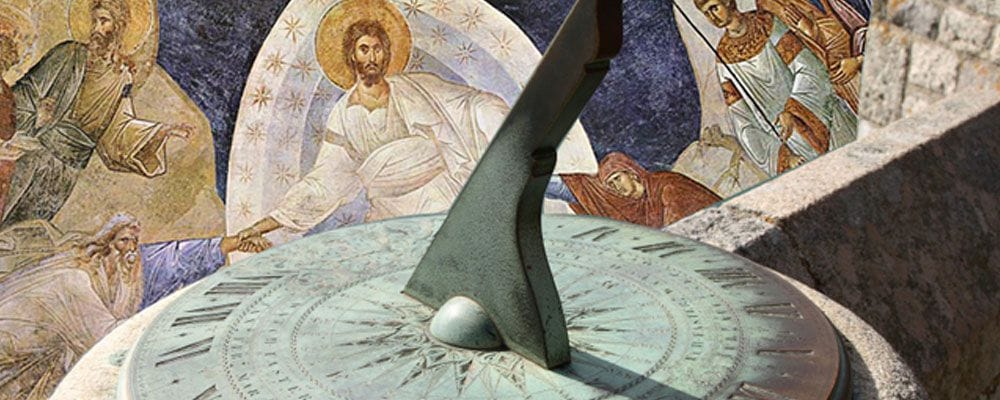
In the Orthodox understanding, what occurred on Mt. Tabor was not a momentary change from the human form Christ had assumed (which was in every respect like ours) to the form He would assume after His resurrection (as Western scholarship often sees it), because Christ was actually always the same, resplendent with the divine light emanating from His divinizing flesh. He did not appear glorious in a brief transformation of His body, but He was always in His divine glory (John 17:5), which, however, was veiled for those who were unworthy to contemplate it, while others saw it and testified about it (John 1:14).

Christ is Always the Same

The witness of the Fathers of the Church is that Christ’s humanity after His resurrection is not different from what it was before. St. Gregory the Theologian states:

In my view, He will come as He appeared or was manifested to the disciples on the Mountain.1

St. John Damascene as well explicates somewhere what took place:

His holy Body at no time remained deprived of the divine glory. From the moment of the hypostatic union of the two natures, the divine and the human, the body of Christ was enriched with the glory of the invisible divinity.

St. Gregory Palamas elucidates further this understanding, declaring that Christ has one body, one human nature, not three: one at His Transfiguration, another outside His Transfiguration, and yet another after His resurrection. Thus, he states,

when Christ was transfigured He neither received anything different, nor was He changed into anything different, but was revealed to His disciples as He was.2

Elsewhere St. Gregory Palamas returns to the subject stating:

Indeed, not only will Christ be eternally thus in the future, but He was such even before He ascended the Mountain.3

He then adduces St. John Damascene as his witness:

Christ is transfigured, not by putting on some quality He did not possess previously, nor by changing into something He never was before, but by revealing to His disciples what He truly was, in opening their eyes and in giving sight to those who were blind. For while remaining identical to what He had been before, He appeared to the disciples in His splendor; He is indeed the true light, the radiance of glory.4

St. Gregory Palamas also offers the following comment in the form of a rhetorical question:

Moreover, the transformation of our human nature, its deification and transfiguration—were these not accomplished in Christ from the start, from the moment in which He assumed our nature?5

Then at the end of the following unit he adds:

Therefore Christ possesses this light immutably, or rather, He has always possessed it, and always will have it with Him.6

Metropolitan Hierotheos Vlahos states:

Christ revealed what He had been concealing, He manifested the glory of the divinity with which His human nature was united from the moment of His conception in the womb of the Theotokos.7

A contemporary theologian also states concisely the Orthodox faith received:

His human nature was glorified from the womb of the Theotokos, but until then it was not shown … Now for the first time the eyes of the disciples were opened to see what Christ had from the moment of His incarnation. That is, in reality it was not Christ who was transfigured, but the eyes of His disciples, to be able to behold the uncreated light.8

We Need to be Transformed to See Him as He Is

This last statement, i.e. that it was not Christ who was transfigured, but the eyes of His disciples, to be able to behold the uncreated light, is the teaching of St. Maximos the Confessor, who writes:

They passed over from flesh to spirit before they had put aside this fleshly life, by the change in their powers of sense that the Spirit worked in them, lifting the veils of the passions from the intellectual activity that was in them.9

St. Gregory Palamas confirms:

At that moment, the initiate disciples of the Lord ‘passed…from flesh to spirit’ by the transformation of their senses, which the Spirit wrought in them, and so they saw that ineffable light, when and as much as the Holy Spirit’s power granted them to do so.10

Elsewhere he also states that,

He was divine before, but He bestowed at the time of His Transfiguration a divine power upon the eyes of the apostles and enabled them to look up and see for themselves.11

The Agioreitikos Tomos incorporates this teaching of the Orthodox Church:

He is transfigured, not by assuming what He did not possess, nor by changing into what He was not, but by revealing Himself as He was to His disciples, opening their eyes and healing their blindness.12

Therefore the appearance of the Lord in His glory did not add anything to the glory that He possessed since His conception. It was a revelation and a manifestation of His eternal glory, an unveiling of the underlying splendor of His divine body in a way visible to the transformed eyesight of His disciples. The disciples were granted the grace to behold Christ’s glory, veiled oeconomically in the “form of a servant” (Phil. 2:7), in order to carry on the plan of salvation.

Thus we see that for a brief time, the veil was drawn aside, and the disciples were enabled to contemplate the radiance of His glory, “not entirely, so that they may not lose their life together with their eyesight”13 that revealed Him as He truly was.

The Hymnology of the Church

The Transfiguration was witnessed “so that when they would see [Christ] on the Cross, they would know that [He] suffered willingly.” —Kontakion of the Transfiguration

The hymnology of the Church as well declares that the eyes of the disciples were allowed to see on Mount Tabor what was Christ’s habitual or natural appearance. Both the Troparion and the Kontakion of the Feast of Holy Transfiguration mention that the disciples saw as much of Christ’s glory as they could bear.14 Christ lifts up the veil a little so that the disciples would get a glimpse of the glory with which He was surrounded, or rather the glory emanating from His divinizing human body. The purpose of it is stated in the Kontakion: “so that when they would see You on the Cross, they would know that You suffered willingly,” because it was obvious that He was God almighty in the flesh, and therefore if anything would happen to Him, they would know that it would happen voluntarily; only if He would allow it.

It is as if the Lord had told His disciples, “Look at me.” Indeed I am “the Son of the living God” (Mt. 16:16) you confessed me earlier, confirmed by the voice of my Father, “This is my Beloved Son, in whom I am well pleased.” (Mt. 17:5) Know then that the Passion is not forced upon me, but I walk voluntarily toward it, to save the lost sheep… This explains why Christ appeared to them in “garments of skin” (Gen. 3:21), the garb of man after the fall, whereas being the “heavenly One” (1 Cor. 15:49) He was always clothed in the splendor of uncreated light.

The glory of the Lord is seen in the iconographic depiction of Holy Transfiguration.15 We see that the light does not come from the outside, but emanates and radiates out of the Light-giver Christ. The light did not appear temporarily, to shine for a time and then fade away. It is the uncreated eternal light, His light, the light of His glory, which always radiates from His “glorious body” (Phil. 3:21).

The “cure” of fallen man consists in his participation in the uncreated light that originates from the divine body of Christ. We are all called to resemble Christ, because only then, as a hymn states, “those who attain the height of virtue will also be counted worthy of the divine glory.” (Third Idiomelon of Vespers)

So, was Christ transformed? From the perspective of the three disciples, He was, as from our perspective the sun rises and sets, while remaining the same.


The subject of Christ’s holy Transfiguration is treated together with that of His holy Baptism in Unit 42 (pp. 428-39, particularly in pp. 434-39), of Fr. Emmanuel’s book, Jesus: Fallen? The Human Nature of Christ Examined from an Eastern Orthodox Perspective (Orthodox Witness 2013).

  1. Letter to Cledonius 101.
  2. hom. in Transfig. 34.13.
  3. Triads 3.i.15.
  4. hom. 34.12-13.
  5. Triads, 3.i.15.
  6. Triads, 3.i.16.
  7. “The Transfiguration of Christ” in The Feasts of the Lord, p. 147.
  8. Meletios Vadrahanis, “What Reveals the Transfiguration of Christ,” Orthodoxos Typos, No. 1890, Aug. 5, 2011.
  9. To Eutropius 2.10.
  10. hom. 34.8.
  11. Triads, 3.i.15.
  12. PG 150:1232C.
  13. Third Sticheron of the Lite of the Vespers of August 6.
  14. The Great Horologion, p. 434.
  15. See the study The Uncreated Light, An Iconographic Study of the Transfiguration in the Eastern Church by Solrunn Nes, 2007.

GIVING WITNESS TO THE TRUE CHURCH

Orthodox Christians all over the world have received the unchanging Christian Faith, passed down from the Holy Apostles to their successors, and continue to practice it today in the One Holy Catholic and Apostolic Church – The Orthodox Church.
%%tb-image-alt-text%%

How the Date of Pascha is Determined

orthodox pascha date

Most Christians, both Protestant and Roman Catholic, celebrate Easter on March 31 this year. Our Pascha, however, has to wait another five weeks, until May 5th. How come? We’ll try to provide a brief explanation to a very complex problem.

There are three calculations for determining the date of Pascha. The first was established by the First Ecumenical Synod of Nicaea (325) and followed by all Christians, Protestant, Roman Catholic and Orthodox alike:

(1) Pascha falls on the first Sunday after the first full moon after the vernal equinox

(vernal means spring; equinox means equal night, when the sun crosses the equator marking the first day of spring and when daytime and night-time are of equal length). Alas, calculations to establish the dates of the vernal equinox and full moon are not based on actual astronomical data, but on fixed dates, obtained through methods used by the Church for convenience, which, in order to simplify things, we will disregard.

A significant factor in the discrepancy between Western and Eastern Christianity is that

(2) The Orthodox Church calculates the vernal equinox based on the Julian calendar

(established by Julius Caesar in 46 BC), whereas the Western churches calculate the vernal equinox according to the Gregorian calendar (established by Pope Gregory XII in 1582). At the time the Julian calendar trailed behind the Gregorian by 10 days. Currently it trails by 13 days, and by the end of the century by one more day (one day is added every 133 years or about a week per millennium).

The Orthodox Christians also add a condition in the calculation of Easter Sunday the other Christian bodies do not:

(3) Easter Sunday must be after the Jewish Passover.

If our Pascha falls on or before the Jewish Passover, it is postponed to the following Sunday. Since the westerners do not follow this rule it happens that on occasion they celebrate their Easter before the Passover, which does not follow the historical event and is against the tradition of the Church.

This year (2013)

The vernal equinox this year is March 20 (it almost always is on this date, but sometimes it falls on the 19th or the 21st of March), and full moon is March 27, so the first Sunday after that is March 31—the date of Easter for all western Christians.

As we said above, since the Julian calendar is 13 days off, when we add the 13 days to March 20, the vernal equinox is calculated to fall on April 2. The next full moon is April 25. The Orthodox Pascha should fall on the following Sunday, April 28, but it does not, because of other complicated calculations. Thus, this Sunday is disregarded for the following Sunday, May 5. That’s the best I can do. Next year is more straightforward.

Let’s now figure out when our Pascha is next year, 2014.

  1. Vernal Equinox       March 20
  2. First full moon        April 15
  3. First Sunday           April 20         Western Easter
  4. Jewish Passover      April 14

Vernal Equinox is March 20 + 13 = April 2. First full moon is April 15. First Sunday is April 20. Since the Jewish Passover is April 14, the Orthodox Pascha is celebrated on the same day as the Western Easter.

Now you figure out when the Western Easter and our Pascha will be in 2015.

1. Vernal Equinox is March 20, first full moon is April 4, and Jewish Passover is April 4. On which Sunday falls the Western Easter?

April 5, 12, 19, 26 (choose one)

2. On which Sunday falls the Orthodox Pascha?

April 5, 12, 19, 26 (choose one)


Answer to the date of Western Easter and Orthodox Pascha in 2015

March 20 + 13 = April 2. First full moon April 4. First Sunday after that is April 5 on which falls the Western Easter. However, because the Jewish Passover falls on the same day, Pascha is celebrated on the following Sunday, April 12.

Let’s try one more: when is Pascha in 2016?

Vernal Equinox is March 20. First full moon is March 23. First Sunday after that is March 27. Western Easter is on this day. Orthodox Pascha is March 20 + 13 = April 2. But since the Jewish Passover is April 22 the Sunday after that, or May 1, is the Orthodox Pascha.

A few additional facts

This year our Pascha is late. Do you know how late it can be? The latest possible date is May 8, according to the new (Gregorian) calendar. This occurred in 1983. The maximum lag of the Orthodox Pascha is five weeks, which occurs this year. The earliest possible date of Pascha is April 4 (it occurred in 2010, the only time in the entire century).

When do we celebrate Pascha on the same day as the western Christians?

There are those who think that every four years we celebrate Pascha on the same day as the western Christians. This is incorrect. This happens only when the first full moon after the vernal equinox falls after March 28. While next year, 2014, we celebrate Easter on the same day, the next time this will happen is three years later and then after eight years (2025). Then it will be every three years until 2037, after which it will be the following year (that is, we will celebrate on the same day for two consecutive years, something that happened in 1990-1991—if you remember).

Why do we avoid celebrating our Pascha on the same day with the Jewish Passover?

Although we kept the Jewish name Pascha (Pesach, is Hebrew, which means passage), what we celebrate is totally different. The Jews commemorate the passage of the Angel of death, and secondarily the passage through the Red Sea; we Christians celebrate the Resurrection of our Lord and Savior Jesus Christ from death to life. The Church wanted to distance itself from Judaism and established a separate date.

Fr. E.H.

GIVING WITNESS TO THE TRUE CHURCH

Orthodox Christians all over the world have received the unchanging Christian Faith, passed down from the Holy Apostles to their successors, and continue to practice it today in the One Holy Catholic and Apostolic Church – The Orthodox Church.
%%tb-image-alt-text%%

Is it Necessary to Bless Icons?

Concerning the Seventh Holy and Ecumenical Synod, 787 AD
from The Rudder, compiled by St. Nicodemus, p. 419 – 420

It is not necessary to anoint the holy icons with myron (or chrism oil), or to have them sanctified by the bishop with special prayers:

1) because we do not adore the holy icons because they are anointed or have had prayers said over them, but irrespectively, as soon as we lay eyes on a holy icon, without pausing to examine into the possibility of its having been anointed or having had a special prayer said over it, we at once proceed to pay adoration to it both on account of the name of the Saint and on account of the likeness it bears to the original. That is why in Act 6 of the present Council, the Council of the iconomachs [iconoclasts] in the reign of Copronymus disparaged the holy icons by asserting that the name of the pictures neither has any sacred prayer sanctifying it, in order that from what is common it might be transferred to what is holy, but that, on the contrary, it (sc. the picture) remains common and dishonorable (i.e., not entitled to honor), just as the painter made it. To these allegations the holy Seventh Council replied through Deacon Epiphanius, by asserting that it did not say that any special prayer is said over the icons, but said that like many other sacred objects they were incapable of receiving (benefit from) any special prayer, but, on the contrary from their very name they are replete with grace and sanctity,[pullquote]…like many other sacred objects they were incapable of receiving (benefit from) any special prayer, but, on the contrary from their very name they are replete with grace and sanctity…[/pullquote] in the same way that the shape of the vivifying Cross is, which is entitled to veneration and adoration among us in spite of the fact that it is made without having any special prayer said over it, and we believe that with its shape alone we acquire sanctity, and with the adoration which we pay to it, and the marking of it upon our forehead, and the seal of it which is made in the air with the finger (note that in days of yore the sign of the Cross was not made with three fingers, as it is today, but with one finger alone, which fact is stated by St. Chrysostom in one of his discourses; and see concerning this the Footnote to e. XCI of Basil) in the hope of chasing away the demons. Likewise, in the same way that we have many sacred vessels, and kiss and embrace them fondly, and hope to receive sanctity from them, in spite of the fact that they have not had any special prayers said over them, so and in like manner by fondly kissing and embracing and paying honorary adoration to a holy icon that has not had special prayers said over it we partake of sanctity, and are anagogically lifted up and carried back to the honor of the original through the name of the icon. But if the iconomachs cannot assert that the sacred vessels are dishonorable and common because of their not having had any special prayers said over them for the purpose of sanctifying them, but are just as the weaver, the painter, and the goldsmith finished them, yet they regard them as holy and precious; in the same way they ought to regard the venerable icons as holy and precious and sacred even though they have not had any special prayers said over them to sanctify them (p. 844 of vol. II of the Conciliar Records).

2) The holy icons do not need any special prayer or any application of myron (or chrism), because, according to Dositheus (p. 658 of the Dodecabiblus) it is only the Papists (or Roman Catholics) that perpetrate the iniquity of qualifying pictures with certain prayers and devotions. For they boast that the Pope manufactures pictures from pure wax, holy oil, and water of sanctification, and that he reads marvelous prayers over them, and that because of these special features these pictures perform miracles (just as they lyingly state that Leo III sent such a picture to King Charles of France, and he reverenced it; [pullquote]Do you see that the prayer which is read over holy pictures is a Papal affair, and not Orthodox…[/pullquote] and that Pope Urban sent another picture to John Paleologus, and this one was honored with a litany in the Church). Do you see that the prayer which is read over holy pictures is a Papal affair, and not Orthodox; and that it is a modern affair and not an ancient one? For this reason no such prayer can be found anywhere in the ancient manuscript Euchologia [church prayers]. In fact, we have noticed that this prayer is not even found in Euchologia printed only a hundred years ago!

3) It becomes evident that holy icons do not need any special prayer or application of myron (i.e., holy oil), because the pictures painted on the walls of churches, and in their naves and in their aisles, and in general in streets and on doors, and on the sacred vessels, are never anointed with myron and never any special prayer said over them, and yet, in spite of this, adoration is paid to them relatively and honorarily by all on account of the likeness they bear to the originals. That is why the erudite Bishop of Campania Sir Theophilus the Saint did not conceal this truth, but stated in the book which he has just recently produced that the holy icons do not need any anointing with myron nor the saying of any special prayer by a bishop.

Photo of author
The Orthodox Witness website is published by Anthony Hatzidakis.
Item added to cart.
0 items - 0,00 $