Orthodox Christians all over the world have received the unchanging Christian Faith, passed down from the Holy Apostles to their successors, and continue to practice it today in the One Holy Catholic and Apostolic Church – The Orthodox Church.
Did you work in my field?
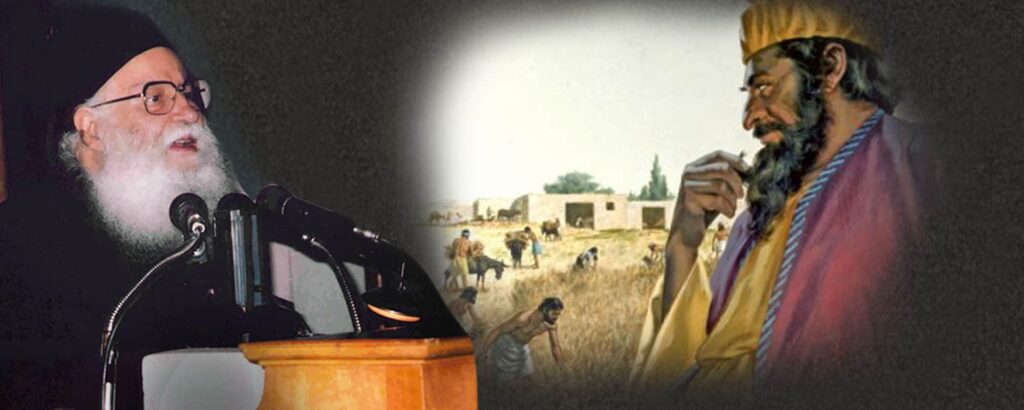
One day Abba Isaiah went to a field where the harvest had just ended, and the owner was paying the workers for their labor.
Among the workers there were also a few monks, as was common in those days because of their poverty.
The time came to pay the monks who had worked, and Elder Isaiah went up alongside them.
When his turn came, the landowner didn’t give him anything, but asked him sternly:
– Father, did you work in my field?
– No.
– Well, then, how can you expect to be paid?
– So, if someone doesn’t work he is not entitled to payment?
– Not at all, that’s correct!
Some who stood there laughed at how dense the monk was, while others were scandalized. Then a couple of monks were so bold as to admonish Father Isaiah:
– What do you think you are doing? Why did you do that? Don’t you know that you have no right to be paid?
The Elder answered sternly:
– I knew it, and very well indeed! I did it for you! Because I see that while for material things you know well that whoever doesn’t work has no right to be paid, yet for acquiring the spiritual things, such as the virtues of sympathy and kindness toward our fellow man, love and compassion for the sick, and drawing near to Christ, you expect to be paid in Heaven for work you have not done on earth!
So the monks understood the lesson and were edified by Abba Isaiah.
Orthodox Christians all over the world have received the unchanging Christian Faith, passed down from the Holy Apostles to their successors, and continue to practice it today in the One Holy Catholic and Apostolic Church – The Orthodox Church.
The “Jesus Prayer”: 11 quotations from the Saints
The “Jesus Prayer” is called “the lifeline of the soul and of the body”, the “foundation of perfection”, a “spiritual weapon” and the “source of all good works”. May we all learn from the Saints to acquire prayer without ceasing.
What was the Canaanite woman shouting behind Christ? What was she begging for? “Have mercy on me, Lord, son of David; my daughter is badly demon possessed…”1 And after the Lord tested her faith, to set an example for future generations until this day, He worked the miracle and said: “O woman, great is your faith! Let it be done for you as you desire.”
From this “Lord, have mercy” begins also the theology of the Noetic Prayer of the Heart.
All the art consists precisely in this. Whether walking, sitting, standing, working, or being in church, keep this prayer unceasingly on your lips and in your heart. By calling on the name of God in this manner you will find peace, you will attain purity of spirit and body, and the Holy Spirit, the Source of all good things, will dwell in you, and He will guide you to holiness, to all piety and purity.
2
What praying the Jesus Prayer prayer does
Saint Paisius Velichkovsky
The Jesus Prayer is work common to angels and humans.
With this prayer people attain to the life of the angels in a short time.
The prayer is the source of all good works and virtues and drives the dark passions far away from man.
In a short time it makes a man capable of acquiring the grace of the Holy Spirit.
Acquire it, and before you die you will have acquired an angelic soul.
The prayer is divine rejoicing.
No other spiritual weapon can so effectively restrain the demons.
It burns them as fire burns a wick.
3
Benefits of the Jesus Prayer
Saint Amphilochios (Makris)
With this prayer, “Lord Jesus Christ, have mercy on me”, you will benefit in every way.
With this prayer man is purified, enlightened, sanctified.
The prayer is the lifeline of the soul and of the body.
The prayer is the foundation of perfection.
You will become ethereal and you will fly with the prayer.
There is no other way to salvation, purification and sanctification than the Noetic prayer. It has filled paradise with holy people.
4
Prerequisites for praying The Jesus Prayer
Saint Paisios the Athonite
Question:
What are the indispensible spiritual prerequisites in order to practice the soliloquy noetic prayer of the heart, “Lord Jesus Christ, Son of God, have mercy on me a sinner”, without the danger of becoming deluded, to be swept away by the devil?
Saint Paisios:
The spiritual prerequisites of the prayer are:
Remembrance of our sins – 5 minutes
Self-reproach, self-criticism, self-accusation for our sins – 5 minutes
Memory of death, Judgment, and hell – 5 minutes
Frequent participation in the divine Mysteries of the Orthodox Church, chiefly repentance, confession, holy Communion.
To have humility, which attracts the divine uncreated Grace.
5
How to pray the Jesus Prayer – I
Saint Joseph the Hesychast
When I arrived on the Holy Mountain, I sought among the righteous hermits those who were practicing the prayer. There were many then – forty years ago – who had life within them. Men of virtue. Old fashioned Elders. From them we made one our Elder and we had their guidance.
Now then, the work of noetic prayer is to push yourself to say the prayer with your mouth, continually. At first rapidly; so that the nous will not be inundated by the waves of formed thoughts. Pay attention only to the words: “Lord Jesus Christ, have mercy on me.” When this is given a good amount of time, the nous gets used to it and it says it. And you are sweetened like when you have honey in your mouth. And all you want is to say it. If it leaves you, you are greatly distressed.
When the nous gets used to it and is filled – when it has learned it well – it then sends it to the heart. Because the mind provides the nourishment for the soul, and whatever good or evil it sees or hears, its job is to bring it down to the heart, the seat of man’s spiritual and physical powers, the throne of the mind; so then, when the one praying restrains his nous from imagining anything, but is attentive only to the words of the prayer, then, breathing lightly with a little compulsion and volition of his own, he lowers it into his heart holds a closed trial within, and says the prayer with rhythm:
– Lord Jesus Christ, have mercy on me!
In the beginning he says the prayer a few times and takes a breath. Later, when the mind is accustomed to staying in the heart, he says a prayer with each breath.
“Lord Jesus Christ” the breath comes in, “have mercy on me” it comes out.
+ + +
Say the prayer “Lord Jesus Christ, have mercy on me” with your tongue and with the nous without ceasing. When the tongue becomes tired let the nous begin. And again, when the nous is burdened, the tongue. Just do not stop. Make many prostrations; keep vigil at night as much as you can… So then, when praying occupies his nous he imagines nothing, but pays attention only to the words of the prayer.
6
How to pray the Jesus Prayer – II
Saint Ephraim of Katounakia
Say the prayer. “Lord Jesus Christ, have mercy on me.”
Say each word one-by-one with attention, with understanding.
Do not proceed to the second word if you have not comprehended the first.
Emphasize the ending more, that is, “have mercy on me.”
Now there will come at first listlessness, sleepiness, restlessness and carelessness but be quick to pull yourself together.
When you say the prayer, consider yourself now at the beginning, that you are in hell and crying loudly, asking for the mercy of God.
Distance yourself from despair, hopelessness and similar feelings.
During the time of prayer do not admit any imagination, or form, or image of the Holy Virgin and of Christ or any other saint, nor should you see the words of the prayer noetically.
7
Why we must pray without ceasing
Saint Paisios the Athonite
We must continue to say the prayer without ceasing. Within our heart and our nous, only the name of our Christ must remain. Because when we leave the prayer, our communication with God, then the devil starts with thoughts and he makes our mind spin, and we no longer know what we want, what we are saying and what we are doing.
The name of Jesus, the noetic prayer, say the holy Fathers, is a flask of myrrh.
You open it, you tilt it and the myrrh pours out, filling the room with fragrance.
You cry out, “Lord Jesus Christ,” and the fragrance of the Holy Spirit exudes from all the senses and from every cell of your body; you receive the “dowry of the Divine Spirit”.
9
The need for struggle in prayer
Saint Sophronios of Essex
Stay with the prayer, keep struggling, and you will pass the day without sin. Everything else will be given from God Himself.
10
Those who pray without ceasing are blessed
Saint Paisios the Athonite
Blessed are those who have Christ in their hearts as their axis and joyfully revolve around His holy name, noetically and without ceasing.
11
Prayer is the most important thing
Saint Ephraim of Katounakia
All the Holy Fathers cry out that the most important thing in the life of every Christian is prayer.
Do you want to put your life in order? Pray.
Do you want to be saved? Pray.
All prayers are good and holy, but noetic prayer is the queen of them. “Lord Jesus Christ, have mercy on me.”
From this little but all-powerful prayer, the Holy Fathers were set in motion and became shining stars of the church.
Say this little prayer unceasingly as much as you can, day and night, and it will teach you that which you desire, that which you do not know.
(Mat. 15:22) And behold, a Canaanite woman from that region came out and cried, “Have mercy on me, O Lord, Son of David; my daughter is severely possessed by a demon.” But he did not answer her a word. And his disciples came and begged him, saying, “Send her away, for she is crying after us.” He answered, “I was sent only to the lost sheep of the house of Israel.” But she came and knelt before him, saying, “Lord, help me.” And he answered, “It is not fair to take the children’s bread and throw it to the little dogs.” She said, “Yes, Lord, yet even the dogs eat the crumbs that fall from their masters’ table.” Then Jesus answered her, “O woman, great is your faith! Be it done for you as you desire.” And her daughter was healed instantly.
The Orthodox Witness website is published by Anthony Hatzidakis.
Orthodox Christians all over the world have received the unchanging Christian Faith, passed down from the Holy Apostles to their successors, and continue to practice it today in the One Holy Catholic and Apostolic Church – The Orthodox Church.
THE HEART: The instrument unknown to science
by Hiero-Confessor St. Luke, Archbishop of Simferopol and Crimea1
“When we look at modern science as it was created by scientists like Lamarck and Darwin, we see the opposition and I would say the absolute discrepancy that exists between science and religion on issues concerning the basic problems of existence and knowledge. For this reason, an enlightened and logical mind can not simultaneously accept both and must choose between religion and science.” –Ernst Haeckel
Saint Luke of Crimea
These words were written 65 years ago by a well-known German zoologist, Darwin’s fervent supporter, Haeckel, in his book “The Riddle of the Universe,” which was very successful and, as it seemed, proved that faith is an absurdity. So, Haeckel2 says, every human being with enlightened intellect must choose between science and religion and follow either one or the other. And he considers it necessary that these people should deny religion, because a reasonable person cannot deny science.
Is this really necessary? No, not at all, for we know that many and great scientists were at the same time very faithful people. Such was, for example, the Polish astronomer Copernicus, who laid the foundation for all modern astronomy. Copernicus was not only a believer, but also a clergyman. Another great scientist, Newton, when he spoke the word God was always taking off his hat. He was a very faithful man. A great bacteriologist of our time and almost our contemporary, Pasteur, who laid the foundations of modern bacteriology, began all his scientific work with a warm prayer to God. Ten years ago, a great scientist and compatriot, physiologist Pavlov, who was the creator of the new brain physiology, left this life. He was also a very faithful man. Will Haeckel dare to say that these people do not have an enlightened intellect because they believed in God?
Scientists who were men of faith
So what happens? So why is it that today as well, there are some university professors, that I know personally, who are people of great faith? Why don’t all scientists deny religion, and only but a part of them have a way of thinking similar to that of Haeckel?
Because these people only believe in matter and deny the spiritual world, they do not believe in the afterlife, they do not accept the immortality of the soul, and, of course, do not accept the resurrection of the dead. They say that science does everything, that there is no secret in nature that science cannot discover. What can we answer to this?
We will answer them as follows: You are absolutely right. We cannot limit the human intellect that explores nature. We know that today science knows only a part of what we ought to know about nature. We also know that the potential of science is great. In this they are right, and we don’t question it. So what do we question? Why don’t we deny religion, as they do, and do not regard it as contrary to scientific knowledge?
Only because with all our heart we believe that there is the spiritual world. We are certain that besides the material world there is a vast and incomparably higher spiritual world. We believe in the existence of spiritual beings that have a mind much loftier than we humans have. We believe, with all our heart, that above this spiritual and physical world there is Great and Almighty God.
What we are questioning is the right of science to explore with its methods the spiritual world. Because the spiritual world is not investigated using the methods we employ to explore the material world. These methods are totally inappropriate for the investigation of spiritual worlds.
Do we know of a spiritual world anywhere? Who told us it exists? If those who ask us are the same people who do not believe in divine revelation, we will answer them, “our heart has told us.” Because there are two ways to get to know something, the first being that about which Haeckel speaks and which science uses to understand the material world. But there is also a different way that science does not know of, and does not want to know, and that is knowledge through the heart. Our heart is not only the central organ of the circulatory system, it is also an instrument by which we know of the other world and acquire the highest knowledge. It is the instrument that enables us to communicate with God and the higher world. We disagree with science only in this.
Considering the great successes and achievements of science, we do not deny its great importance at all, and we do not restrict scientific knowledge. We only say to the scientists, “You do not have the ability to explore the spiritual world with your methods, but we can do it with our heart.”
There are many unexplained phenomena, which are nevertheless true (as is true a natural phenomenon) and concern the spiritual world, and so there are phenomena that science will never be able to explain, because it does not use the appropriate methods.
Let science explain to us how the prophecies appeared about the coming of the Messiah, all of which were realized. Can science tell us how the great Prophet Isaiah, 700 years before the birth of Christ, foretold the most important events of His life, for which reason he was called an evangelist of the Old Testament? Explain to us the insightful grace of the Saints and tell us by what natural methods the Saints have obtained this grace, and how they could, just by seeing an unknown person, immediately understand his heart and read his thoughts? They saw a man for the first time and called him by his name. Without waiting for the visitor to ask, they responded to what was worrying him.
If they can, let them explain it to us. Let them explain how the saints foretold the great historical events which, over time, were realized exactly as they had prophesied. Let them explain to us the visits from the other world and the appearances of the dead to the living.
They will never explain to us why they are far from what is the basis of religion—from faith. If you read the books of those scientists who try to overthrow religion, you will see how superficially they see things. They do not understand the essence of religion, yet they judge it. Their criticism does not touch the essence of the faith, which they cannot understand, but the rituals, that is, the manifestations of the religious sentiment. They do not understand the essence of religion and faith. How is this? Because the Lord Jesus Christ says, “No one can come to me, unless the Father who sent me draws him to me.” (John 6:44)
So the Heavenly Father must draw us; the grace of the Holy Spirit must illumine our heart and mind; through this enlightenment, the Holy Spirit must dwell in our heart and mind; and he who is found worthy to receive this gift acquires the love of Christ by keeping His commandments. Only those who have acquired the Holy Spirit, those in whose heart Christ dwells, together with His Father, know the essence of faith. The others, the outsiders, do not understand it at all.
Let’s hear the criticism of a French philosopher, Boutroux,3 against Haeckel. Boutroux says the following:
“Haeckel’s criticism is concerned more about the rituals than the substance, and sees the rituals from a view so materialistic and so narrow that not even people that are religious can accept. Thus, the criticism of religion by Haeckel does not refer to even one of the principles professed by religion.”
This, then, is our view of Haeckel’s book “The Riddle of the Universe,” which to this day is considered a “gospel” for all those who criticize religion, deny it, and find it contrary to science. Do you see that the arguments they use are very poor and without substance? Do not be scandalized when you hear what they say against religion, since those who say it do not understand its essence. You simple people, who have little to do with science, and do not know much about philosophy, always remember the most basic principle, which the early Christians knew very well. They considered unhappy the man who knows all the sciences, but does not know God. On the contrary, they considered blessed the man who knows God, even if he knows absolutely nothing about the earthly things.
Guard this truth as the greatest treasure of your heart. Move forward and look neither to the right or to the left. Let not what we hear against religion make us lose our orientation. Let us keep our faith, which is eternal and indisputable truth. Amen.
Saint Luke, Archbishop of Crimea
“Homilies and Speeches”
Orthodox Kypseli Publications, Thessaloniki
Orthodox Christians all over the world have received the unchanging Christian Faith, passed down from the Holy Apostles to their successors, and continue to practice it today in the One Holy Catholic and Apostolic Church – The Orthodox Church.
Breaking the logic barrier
by Protopresbyter George Christodoulou | October 16, 2020
Regarding recent public statements about Holy Communion by a professor of Genetics but also by politicians, I would like to express some thoughts simply and freely.
The purpose of this article is not to underestimate science or individuals, but to strengthen the faith of Orthodox Christians who have been affected lately.
First of all, let us accept that priests are also people who get sick and die like everyone else. In fact, many saints of our Church were particularly sickly.
Our Church has responded to the health directives from the outset and continues to respond. Priests wear masks like everyone else, in shops, public services, hospitals, buses, etc., only not during religious services, as the law stipulates. We must take precautions for this virus that currently exists, covid-19, and do what we can to achieve the best possible outcome. That’s logical.
But who has the absolute authority and certitude to force another human being not to accept something different, something outside the realm of reason, such as the mysterious spiritual life?
The scientist is a respected person who studies, researches and strives to improve the life of humanity. Yet he sees only as far as knowledge of his discipline allows. Also, from the little I learned about genetics at Harvard and as our remarkable teachers told us, there are many gaps in genetic knowledge as well as in the ethics of Genetics. Dr. Craig Venter tells The Guardian: “When you concede that we only understand two thirds of the most fundamental cell that we can compile right now, we are probably at about the one per cent level of our understanding of the human genome.”1
My simple thought is how a scientist whose subject has so many unanswered and unexplored gaps can come to an object completely unknown to him, such as the Holy Mysteries of our Orthodox Faith and especially the Mystery of the Mysteries, the Eucharist. The scientists themselves acknowledge that transmission of diseases through Communion cannot be proven.2 Precisely, because in our lives there exists not only what is “logical”; there are also things “beyond logic.” There are things we see, there are also things we do not see.
Our Orthodox Faith, however, has proofs. The Orthodox Priest can contract any disease, but not through Holy Communion, which is God himself.
In practice:
1) The Priests during their lifetime will commune a very large number of people, some with a contagious disease, and they will then consume the sacred “remainder” from the Holy Chalice. Consider that most clergy have spouses and children with whom they later interact with.
2) Father Chrysanthos Koutsoulogiannakis, a priest of Spinalonga3, communed the lepers using the same spoon with which he also finished it at the end. He always gave his hand when greeting and during the distribution of antidoron, and was the last off the island when leprosy was cured and it was abandoned. He died of old age – and not from leprosy.
3) Saint Joseph the Hesychast was literally embracing those who had tuberculosis. He hugged them tightly in his arms out of love. When asked if he was afraid of the disease, he said: “I pray to God every day to allow me to catch tuberculosis so that my soul may be saved, but the disease flees from me.” He passed away at a very old age – and not from tuberculosis.
4) In the life of St. John of Kronstandt, an incident is reported where the father of a Priest he was acquainted with became seriously ill with tuberculosis, and his doctor had given him a maximum of ten days to live. Saint John asked him to leave the hospital, since there was no hope for him to live anyhow, and to go with him to Kronstandt, where there was a church, in order to give him holy Communion. When the doctor learned of this, he said that he would die on the way there. The patient eventually received Communion and remained in Kronstadt for two days, when the hemoptysis [coughing of blood] ceased and his voice returned. When he went back, the doctor said that this was unprecedented. The patient lived another 25 years.
The miraculous treatment of Princess Zinaida Yusupova is also characteristic. She suffered a blood infection after giving birth prematurely. The Saint visited her, as she narrates, sat on her bed and said to her: “Whether you will live or not, it is God’s business. Nevertheless, you must prepare for a new life by receiving the Immaculate Mysteries.” At his insistence she accepted, and after communing with consciousness and joy, she slept for six hours. When she woke up, she was completely healthy! Professor Botkin, who was observing her, seeing such a change, remained silent for a long time. Two tears rolled down his face. Then he whispered pensively: “Such a cure was not achieved by human means.”
5) How many other miracles related to the Priesthood and Holy Communion are recorded in books other biographies, and also in the memory and experience of the clergy. Supernatural facts held for more than 2000 years. If you have ever seen the reaction of a demon-possessed man when he is taken to Holy Communion, you will understand much. No, he is not mentally ill neither does he have any brain damage, he is the man next door.
So, my dear ones, in this life there is not only logic, the scientific point of view, and what we see. There is also the supernatural and those things we do not see, which well from a single truth, Christ!
Holy Communion is alive!
However, let us clarify at this point that whoever wishes to receive the Ineffable Mysteries should know that there are conditions. The Christian, in order to commune, must prepare oneself, in order to become a vessel suitable for receiving God: to be humble-minded, to confess sincerely in order to cleanse his soul with this great sacrament of our Church, not to hate anyone, and to struggle spiritually, cultivating the virtues and his faith.
Therefore we respect the scientific data, but when they fail to explain to us how a wooden icon streams myrrh, and how a mural in Andros (that so many people saw these days) weeps, let us not treat the faithful as irrational beings who do not speak the language of logic. Do not forget that there are also clergy who are scientists, physicians, geneticists, etc., with brilliant studies in Greece and abroad.
We take care, my brethren, of our health, we respect the scientists, but we do not forget what we hear in services that the Priests ask from God: “For this holy house, and those who enter it with faith, reverence and the fear of God, let us pray to the Lord!”
A small island NW of the island of Crete, Greece. It was used as a leper colony from 1903 to 1957. With the discovery of the cure, the leper colony was closed. Father Chrysanthos served the lepers for 10 years. He stayed on the island until 1962, to commemorate the lepers until five years after their death. He reposed in 1972.
The Orthodox Witness website is published by Anthony Hatzidakis.
Orthodox Christians all over the world have received the unchanging Christian Faith, passed down from the Holy Apostles to their successors, and continue to practice it today in the One Holy Catholic and Apostolic Church – The Orthodox Church.
Contemplate the human nature of Christ in 50 slides
Orthodox Christians all over the world have received the unchanging Christian Faith, passed down from the Holy Apostles to their successors, and continue to practice it today in the One Holy Catholic and Apostolic Church – The Orthodox Church.
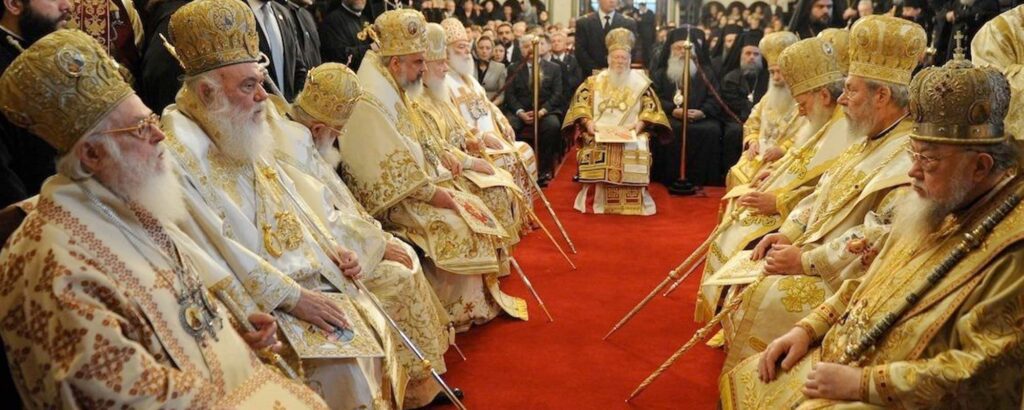
Keep your faith! An open letter to the monks of Mount Athos
On August 26, Metropolitan of Zaporizhia and Melitopolis Luke (Kovalenko) sent an open letter to all the monks of Mount Athos regarding the upcoming visit to the Holy Mountain by Ecumenical Patriarch Bartholomew in October. Metropolitan Luke is with the Ukrainian Orthodox Church (the only Church in Ukraine recognized by all the autocephalous Orthodox Churches with the exception of Constantinople). The letter in the original Russian was published on his telegraph page.
An open letter to the monks of Mount Athos by Metropolitan of Zaporizhia and Melitopolis Luke
Christ is in the midst of us, my dear readers!
Dear and beloved brothers in Christ, my heart!
Today God is visiting us with trials in which we must show the firmness of our faith and unwavering faith to the holy canons of our Mother Church.
On October 19, 2019 arrives by you “Patriarch” Bartholomew, who tarnished his heart and his hands with the betrayal of God and in violation of His holy commandments. Thanks to the action of this person, our holy Ukrainian Orthodox Church is drowned in blood and tears. Priests and parishioners are beaten, churches are seized, and our mass media is throwing mud and slander.
We thank God for giving us the opportunity to show our faithfulness to His Word and to follow His Will.
We ask you to stand in solidarity with us in this faithfulness to Christ and to the canons of the Orthodox Church.
To those of you who stand in true faith, we ask you to remain firm in your convictions, not to yield to any persuasion, or to fear the threats, because God is with us!
Those who, because of so-called “obedience,” are ready to follow the call of the “wolf in sheep’s clothing”, I declare with all responsibility for the following words of mine before God and before His Holy Catholic and Apostolic Church: you betray Christ!
It is not the father and the good shepherd who is coming to urge you to recognize the schismatic nationalists as the canonical Church, but a thief and a robber. It is not the bearer of the “image of meekness,” but the successor in spirit and the follower of the work of Nestorius, Sergius I and other heresiarchs, John XI Vekkos, Meletios IV Metaxakis and Athenagoras Spirou, the same as he, servants of the enemy of the human race. The ill-fated Mr. Bartholomew already lost the right to be called not only a patriarch but also an Orthodox Christian.
The statements of some of you, who are ready to recognize the actions of this person as lawful for the incorporation of unrepentant dissenters into the Church’s body, only for the sake of securing the opportunity to venture on the Holy Mountain in the future, causes deep sorrow.
With tears, I ask you to think, “Is it worth the thirty silver coins to betray your faith and beliefs? Do ordinary fear, cowardice and treachery hide behind the word ‘obedience’? Will your prayers and accomplishments bought at such price be pleasing to God?”
The price of this betrayal is a reservation at the Last Judgment of the place next to Judas and the torturers who crucified our Lord. Our Church is already paying for this betrayal with blood and pain. Do you want to be condemned with our executioners, or, perhaps, it is better, having suffered here for Christ, to be glorified with Him? (Rom. 8:17)
Those of you who have decided that “if Patriarch Bartholomew comes with the schismatics from Ukraine, then we will receive him him, because there are no schismatics”, think, who is more guilty: the child or on the mother who gave birth to him and raised him?
We know about the inevitability of terrible times, and the trials we are going through are not the worst. If we cannot be firm in this, then how can we stand in the future?
Answering for every word before God, I am sure that Mr. Archondonis is a man that the devil struck with a dreadful disease—pride, and because of this he made him his weapon. His task is to split the Church, to sow enmity, to tempt the minds, to destroy those who are not firm in faith, to shake the doubters, to bring embarrassment to their minds, and to cause temptation. From a patriarch he becomes an apostle of Satan and a devil for the faithful!
My dear brethren in Christ, I beseech you, along with the apostle, to keep your faith and “keep yourselves from idols” (1 John 5:21)!
I ask your holy prayers for my unworthiness!
Metropolitan Luke Metropolitan of Zaporozhye and Melitopol
Aug. 26, 2019
This translation was made from a Greek rendering and from a modified Google translation from the Ukrainian by Fr. E.H.
The Orthodox Witness website is published by Anthony Hatzidakis.
Orthodox Christians all over the world have received the unchanging Christian Faith, passed down from the Holy Apostles to their successors, and continue to practice it today in the One Holy Catholic and Apostolic Church – The Orthodox Church.
Elder Emilianos eulogizes Fr. Dimitri Gagastathis
The renowned Elder Emilianos, former Abbot of Simonos Petra Monastery on Mt. Athos, reposed in the Lord today (May 9, 2019). The text that follows is a translation of a eulogy he wrote for Fr. Dimitrios Gagastathis (+1975), a simple married priest who, he said, “walked among us but his ‘association was in the heavens’” [Philippians 3:20].
This eulogy is an excerpt from the book, Papa-Dimitri: The Man of God, a book comprised of autobiographical notes, his prayers, and testimonials.
Papa-Dimitri at the church of the Archangels.
Having been away by necessity when Heaven opened its gates to receive that blessed one who has been taken up “like an eagle’s fledgling raised in height” and now rests among the saints—Papa-Dimitri… And having not been able to venerate him, the holy priest, the prophet of the heavenly mysteries—as Saint Macarius would say—the son, the lord, the god, who had been bound down, captured, and consecrated as a sacrificial offering… Having lost the opportunity to be present among the friends and relatives of my beloved Papa-Dimitri when they interred his precious relics behind the sanctuary of the Church of the Archangels…
I am now writing down these few lines, deluding myself with the thought that I was also present at that time. In reality, however, by writing these words, I feel like I am only making a prayer-rope in front of the elder, who now rests in silence, having gathered the grace of the Holy Spirit and having given rest to God and to the whole heavenly Church.
I feel as though I am visiting again his humble house—in particular the room with the multitude of the saints’ icons—and yet once more, his fortunate flock in order to deliver one of the sermons or to hold one of the vigils that we did together—this time, however, without him. For Heaven has snatched him up, clouds have covered him, the feasting company of the Firstborn has received him. We have no doubt about it because we have lived with him and have gotten to know him personally; and this is what we saw in his life:
A Life Guided by Grace
His life flowed naturally, in simplicity and ingenuousness of heart; at the same time, though, it was a continuous journey, an ascent towards God, a constant experience of God’s revelation. Papa-Dimitri lived in a world of miracles; his life can credibly be explained only as a continuous intervention of Divine Grace.
The sure place to find him was always the Church of the Archangels—ever since he was a little child. He grew up in the half-lit church. There he would keep vigil, read the Scriptures, chant in the dim light of the oil-lamp, all the while in company with his beloved Archangels—Gabriel and Michael—his personal friends and companions. Before their old icon hanging on the iconostasis, he would recount everything, and through them accomplish everything.
Papa-Dimitri proved to be unqualified to assimilate the spirit of this world. Thinking with “the mind of Christ”, he bore another kind of spirit, a different kind of mentality.
When young, he was spiritually nurtured by the most pious Father Iakovos, Abbot of Metéora, a hieromonk who left a memory of virtue and holiness. The Holy Spirit must truly have found Papa-Dimitri a suitable instrument through whom to express Himself. Papa-Dimitri would often go to Metéora to meet with Father Iakovos, and after the abbot’s death, to trace his spiritual inheritance. In like manner, he would go everywhere he heard there were monastics sincerely conforming to the life of Christ.
Before committing himself to any course of action, or in deciding whether to accept a given situation, he would always consult those whom he saw being led by the Spirit. Being thus free of any self-will, he would consistently bow down before the Truth.
He would also regularly entreat his beloved Archangels, pour out his heart to the Most Holy Theotokos, and address himself to the very God, “rising early at night.” Wondrously, Heaven never remained silent. He used to say, “For whatever I want, I first put on the stole and then take up the prayer-rope.” Anxiety was foreign to his nature, as were also uncertainty, apprehension, irresolution.
He abandoned himself to God, and being thus “steered by Grace,” he walked joyfully, “picking the sheaves in gladness” [Psalm 126:6], that is, witnessing signs and miracles, experiencing divine revelations, undergoing heavenly changes. God walked in him and he walked alongside God. He sought to be in union with Him day and night—particularly under the stars at night—until such time as “Divine Grace, who dwelt in him in abundance, bolstered him entirely, strengthened him completely, and took him up from earth into the air to dwell in him forever.”
He loved God in the “fullest sense of his heart,” with “burning of spirit” and “clinging of soul.” He lived for no other reason except for “the Lord to come and dwell in him.” Using these words of Saint Macarius, we could rightly describe the meaning of his life—a life that was truly an outpouring of Divine Grace. Not only was he endowed with the gift of God’s love; he was also adorned with “a raiment of needlework” [Psalm 45:14].
Papa-Dimitri distributing blessed bread.
When the Word finds a dwelling, when He finds a God-loving response to His knocking [Rev. 3:20]; when, in His chase, He captures the chased, He unites him with Himself; He transforms, purifies and deifies him, He makes him a divine person—a god by Grace—filled with the gifts of the Holy Spirit.
As alluded to earlier, he had the gift of constant prayer—the prayer-rope frayed away in his hand. When he used to say that he had visited us three times at night, he meant, mentally, through his prayer. In this way, he kept the whole world close to him. Should he have gone somewhere, he would always remember to take along his “prayer kit.” Eventually, when he became bedridden and could no longer go physically to his beloved church to carry out his schedule of services—one of which was the reading of countless names of the living and the dead for commemoration—he started the practice of mentally visiting, first, his home village of Plátanos, followed by Tríkala, and then “every city and town,” commemorating the names of everyone he knew along the way. At night, in the first hour after midnight, he used to knock the handle of a small, nearby dresser with his hand in order to have Presbytera wake up and begin eliciting “Lord have mercy” responses to his entreaties and commemorations.
He also had the gift—bestowed by God—of tears. Almost always, during Liturgy and in his prayers, his countenance would be filled with tears. When celebrating Divine Liturgy before God, “co-serving with the saints,” his disposition was entirely simple, while at the same time, fully uplifted and “many-eyed” [Ezekiel 10:12].
Despite all these acquired virtues, he nevertheless held himself as “unworthy, and the least of all,” his humility being most true. “Do not entreat God for me,” he used to say, “I do not deserve it.” “While I am here, I bring loss to the Church and the people. I, the unworthy servant that I am, cannot bear any fruit. I can only weep for my sins and entreat God for the whole world.”
Everyone who knew him was amazed at the depth of his love and concern for his spiritual children. His patience even horrified the demons.
His days passed in places filled with sweet church fragrances—the delicate scents being diffused also to others at times. He lived in a world susceptible to heavenly miracles. “Tonight, I want a miracle,” he was able to boldly say to his saints. “Where else can I go? I can go nowhere else.” At other times, he would ask them: “Why do you stand by idle? Give also a helping hand!” How could the saints not answer him? How could God turn a deaf ear? He surely hearkened “as He willed and as it was good.”
Let us not expound more upon his gifts, except to add that he was a friend of the Theotokos—he loved her deeply, as did all the saints—and that he possessed the virtue of discretion along with the beauty of a purified soul. Endowed with a blessed ending, he was most assuredly taken up to be with the Beloved, having been made into a vessel of Divine Grace, shaped masterly by the Spirit.
A Life Steeped in Pain and Passion for God
He felt the desire to become an apostle of Divine Grace—a co-worker [1 Corinthians 3:9] in salvation, a mouthpiece [Acts 3:18] of God—when still young. A flame of missionary zeal consumed him, but fear and a lack of education initially held him back. At first, when the Lord’s voice reverberated the question “Whom shall I send?” [Isaiah 6:8] within him, his foremost thought, alas, was: “Behold, I do not know how to speak” [Exodus 4:10]. God nevertheless taught him “what he should suffer for His name’s sake” [Acts 9:16].
He was allured, and once he felt God’s power, he did not cease to recount all the sufferings he should endure for God’s sake. Whatever happened to him afterward, he regarded it as a means and a cause of salvation, both for himself and for others. He, therefore, wanted to have everything brought forth and revealed, either confidentially within private conversations or publicly “from the housetops” [Matthew 10:27], “in the great church congregation” [Psalm 22:25]. Without realizing it, he had begun to follow the apostolic way. For this reason, it was no longer possible for him to live in peace, but only under conditions of misunderstanding, persecution, abandonment, and pain.
The first source of pain for him was the realization—through his illumined and sensitive heart—of the vanity of the world: a world held captive to the law of death and decay, cast away in a state of exile from God. He deeply felt the reality of separation from the One for Whom he should be longing and to Whom he should be constantly crying out with a loud voice.
Simple-hearted and uneducated as he might have been, Papa-Dimitri possessed a divine zeal which taught him “to suffer, and by suffering to recall the glory and freedom of which he had fallen away and which he exchanged for slavery.” Certainly, he must never have read these words but by means of his own words and manner of expression, he would say: “I shout. I shout. Will He not at some time listen to me?” … “You must shout ‘Lord, have mercy’ so that it may reach the ears and strike the heart. … Then contrition comes; tears flow from your eyes. … Then Christ comes, and you feel peace and sweetness within you.”
Every time this saint prayed to God for forgiveness, his whole being quivered mightily. Soaked in tears and sweat, he begged for God’s grace with shouts. “No work, no pay,” he used to say. This daily struggle of Papa-Dimitri ended with an afterglow of salvation as well as with glorification of God and boldness toward Him.
A whole heaven stirred and was illumined within him—its brightness being able to touch others, too. Those who witnessed this for themselves were observing a heavenly sight which concealed his pure and childlike soul. The confessor who would hear his confession would be impressed to think that he had the greatest sinner in front of him. But soon a shiver would overtake him and he would, unwittingly, experience something of the awe that Forerunner John must have experienced when he placed his hand on Christ’s head.
Papa-Dimitri surrounded by children.
Another source of pain for Papa-Dimitri was the love he had for his flock. He was in a constant state of travail with regard to his spiritual children, taking each of their burdens upon himself and weighing them heavily on his mind. Throughout his entire life, this humble priest served them as a witness to the truth of the Gospel, his life’s example becoming itself an evangelical epistle. He became a God-taught writer [Psalms 45:1] of the Heavenly Kingdom, a teacher of the things he himself experienced and endured, an intercessor who “denied himself every hour and suffered many afflictions,” a pastor who prayed “duly, painstakingly, and intensely” for the people of God.
He served Liturgy continuously for his flock, standing as another Habbakuk at his watch [Hab 2:1] and being transformed according to the cherubic chariot of Ezekiel. Many times he served Liturgy for forty consecutive days. He also would read for hours daily his “list of names,” and through such commemoration, would bring his spiritual children into the heavenly sanctuary with him and stir them to kneel inwardly before the hem of the garment [Matthew 9:18-20] of God. How much labor, how many tears, how much pain!
He could suffer no less, of course, to bring peace to the disturbed hearts of the faithful, resolve their differences, protect the poor and the orphans, rectify every injustice. He was the one to run to everyone’s need; he was responsible for all. “Make haste, Papa-Dimitri, run!” he would say to himself, “The Devil has once more encompassed the village!” Whereupon he would grab his stick and not come back until he had met with victory.
How could he find time to sleep? When could he get a chance to rest? He served as the accountable “ruler” [Luke 12:42] of his house, of the village, of the people’s souls, of literally everything under his purview. He was “offered up” [Philippians 2:17] for others.
For any problem that arose, he held that it was he who was ultimately to blame. In his humility, he always considered himself “a sinner,” and so, in the final analysis, it was his personal shortcomings which rendered him responsible. While on the run to settle one matter, he would simultaneously be occupied with another. At times, he would be rebuking himself for not remembering everyone’s name in his commemoration prayers. Whenever he could not recall someone’s name, he would instead murmur out their occupation: “For the president of the community bus service, for the doctor, for the nurse, for the …”
In this way, he would cast everyone before God’s forbearance and, in so doing, help to lift everyone’s burden. His pattern of service reveals not only the intensity of his prayer but also an incessant emptying and melting away of self, pouring out of soul, a “burning care” for everyone—“the daily pressure of care for all the churches” [2 Corinthians 11:28].
Shall we recount as the cause of a thousand martyrdoms the numerous persecutions he suffered and endured? His never-ending afflictions are legendary as are also the animosity and manner of death he endured at the hands of the enemies of the faith, both known and unknown. It was as if the powers of hell had broken loose against him, expressly because he was a faithful steward and apostle of God. Even the priestly hands of fellow clergymen were dishonored in attempts to take his life.
There is no need to dwell on his obvious source of pain, that is, his great many illnesses; or the patience he exhibited— like another Job—when, in his last days, there was no longer “any healing in his flesh” [Psalm 38:4], when it had all turned into one encompassing wound. As things were, it was necessary for him to become equal to the saints in all respects [Hebrews 2:17]—that he come to lack in nothing. His body’s weakness served to strengthen his soul and reveal the power of God [2 Corinthians 12:9]. Indeed, he could only suffer—it was not possible for his life to progress otherwise. He was in pain for the purification of his heart and for the acquisition of God. This constituted the cornerstone of his whole spiritual edifice. Behold, he was “in travail” and “bore a spirit of salvation.”
An Enigmatic Life, a “Strange Mystery”
On the surface, the life and teachings of Papa-Dimitri are plain and simple. He was kind, pleasant, considerate—a meek and delicate man with a sensitive soul, a careful thought, and an affable word. He was easily filled with enthusiasm and expressed his joy candidly. His customary speaking with good humor and by many illustrations created a comfortable and pleasant atmosphere for all those around him.
He sought to please everyone, taking care to neither expose anyone nor put him on the spot. He avoided passing judgment on others and instead tried to justify people for their acts, or simply kept them in confidence. He liked to participate in the discussion only when the topic was not about earthly vanities. His words and manner of expression revealed—as if through a painting—the beauty of his soul. After conversing with him, partakers would leave transformed, filled with thoughts stirring their innermost parts, and burned up by the fire that God, through him, lit within their souls. Papa-Dimitri was a compelling “man-maker.” Nevertheless, his actual life, concealed “in God through Jesus Christ” [Romans 6:11], was hidden from the eyes of men, uncaptured by the tentacles of their earthly reasonings and judgments. Were he not the tangible object of their accusations, he would at least be looked upon with prevailing uncertainty or be considered naïve if not judged an outright egotist. To “spiritual” people, he was a subject of scandal; to a great many, a fool.
But were he not a subject of scandal, had he not lived as a fool for Christ, he would not have been a true man of God—he would have been simply a figure acceptable to psycho-spiritual people. His life can be described only as a “strange mystery,” a living mystery. He walked among us but his “association was in the heavens” [Philippians 3:20]. He was living “as though in another world.” The depth of his soul was well concealed from the eyes of the casual observer.
It could not have been otherwise, of course, as Papa- Dimitri proved to be unqualified to assimilate the spirit of this world. Thinking with “the mind of Christ” [1 Corinthians 2:16], he bore another kind of spirit, a different kind of mentality. Consequently, to the worldly wise, he was incomprehensible. By what earthly criterion can men explain, for example, the ease by which Papa-Dimitri used to talk about himself, mention praises attributed to him, or reveal personal experiences such as the leaps and ascents of his heart? How can they discern the fire which inflamed his soul and made it irrepressible and “imprudent”?
After having listened to Papa-Dimitri talk knowingly about Satan, how could earthly-minded men not be skeptical? Being familiar—at most—with only the passions and afflictions of their own lives, how could they possibly understand what the struggle against the “spirits of evil” [Ephesians 6:12] is really about? The “humble little priest,” however, directly experienced the envy and roaring of the ravenous mental lion [1 Peter 5:8], who, as he disclosed, tempted him with “Saint Anthony’s temptations.” Satan touched upon him [Job 1:11], pressed him and exhorted him to sin, but the humility of the “little priest” dissolved his designs.
Moreover, Papa-Dimitri, while in the midst of people who totter and “change forms in this age” [Romans 12:2], remained steadfast and “uncompromised,” an unswerving man of integrity. To illustrate, while being persecuted by communists— enemies of the Church and the nation during the Greek Civil War—he could have chosen to negotiate the difficult turn of events with a little “cleverness,” knowing that conditions would eventually return back to normal. He chose not to compromise the dictates of his conscience, however, which forced him into a life of hardship, taking refuge at night in the “caves and holes of the earth” [Hebrews 11:38], kneeling down on the damp soil with his hands raised up towards God, asking Him to be his witness and helper. His “friends and kinsmen” [Psalm 38:11] meanwhile shouted for him to “come to his senses.”
Papa-Dimitri held fast to the same uncompromising and resolute guiding principle in all ecclesiastical matters, including problems concerning secularization trends within his flock. It must be stressed though, that his strictness was always coupled with abundant love. As a true priest, he was closely knit to the people, full of love for his fellow man, abundantly merciful, warmly openhearted and sociable. He could always be seen with candies-in-hand for the little children and money-in-hand for the needy. He was even concerned over the village’s public resources such as conference rooms and the library. He paid the people comforting visits, made them goodwill gifts, sent them helpful letters.
Let no one be misled, however, to believe that he was present only to organize, to be active, or to be social. While it is true that he was involved in every facet of the village, in reality, he lived outside of it all—in the peace and security of heaven—empowered by his own mystical life experience. Although married and the father of many children, he lived his life as an ascetic does—in the company of his Lord and God. He was a struggler “dwelling faraway from the beauties of life,” “dwelling within his own heart,” “dwelling in God.” In this world, he possessed nothing but virtues—virtues of the saints and virtues of contemporaries whom he held in admiration— which he painstakingly “gathered up.”
Nowhere would he find rest. He would reveal his emigration from the world and his association [Philippians 3:20] “with all the saints” by running from monastery to monastery and from shrine to shrine. He truly lived together with God, Who spoke to him as he did with all the saints: “through dreams in the night and through the intellect in the day.”
He lived in concert with his beloved Archangels; he associated most comfortably, naturally and “perceptibly” with the saints. The Archangels, as a matter of fact, had much to do with Papa-Dimitri getting married. He once asked Saint Nicholas for his blessing—special permission—to allow him to scatter a disorderly crowd with his stick. Another time, he firmly demanded of Saint George that he revive a dried-up fountain. On another occasion, after being persecuted by enemies, and having prayed to Saint George for deliverance—miraculously— he crossed a swollen stream “with dry feet” exclaiming with unprecedented boldness and simplicity: “Heh! We just got hold of George! We got him—the great benefactor!”
He also greatly venerated Saint Nektarios—he would never fail to read his Salutations. He was especially close to the Mother of God: there is no place he would go without her—he would set out, “sojourn” together, and then return home with her.
Be it the sleep of his body, the watchfulness of his soul, the mystery of his eyes, his speech, his silence—everything was a means of communication with God and with the friends of God. He lived this life in union with the mystical body of the Church and the Kingdom of God, “contemplating the visible, understanding the invisible.”
He had, moreover, taken care to fill every place in and around the village with signs and images of that Kingdom. When he would take visitors around the village to show and explain to them the icons, crosses and other such things as he had erected, the visitors could not help but be impressed to think that some prophet or other biblical figure had been raised from the dead and was now standing right before their eyes.
Someone once timidly said to him: “Papa-Dimitri, you filled our village with churches and crosses—shall we turn it into a monastery?” But Papa-Dimitri knew well what he was leaving behind: “A column to the God of Jacob.” Should those assimilated to this world understand everything? If so, there would be no mystery about the Kingdom of God and not one soul would be “not of this world” [John 8:23]. The words “having received life here in provision and moving toward the future” would be meaningless and that which was taking place in him commonplace. Quite the opposite, Papa- Dimitri saw and evaluated everything from the perspective of eternity.
A “Column Inscription”
There are certain psalms of David that bear the title “Column Inscription.” These psalms were originally intended to be inscribed in columns in order to remind the Israelite people of the specific miracles of God. Above all, the intention was that the psalms would become inscribed deeply in the hearts of the people as a means to foster continuous praise to God.
In our own time also, God has left us one such “Column Inscription”: It is the ground where Papa-Dimitri rests and awaits the sound of the trumpets [Matthew 24:31]. That hallowed ground truly constitutes a hymn of praise to our God, because it covers a saint.
During the procession at the burial of his precious relics, some people exclaimed: “He is like Saint Nektarios!” He is indeed like Saint Nektarios, but not like him only. He is, in truth, like all the saints! “When I find a place there,” he used to say, “I will come and help you. I cannot possibly forget my spiritual children!”
Elder Emilianos
In his last days, amid unbearable suffering, he sought to remain still, composed, his thoughts immersed in and delivered up to God. When visitors came, they thought he was sleeping and would nudge him physically in order to wake him. How crestfallen he would then be! He would later explain to some persons in confidence: “What things, what hymns were these! … Somewhat like what I had once heard, but infinitely superior. Superb ones!”
Oh, Papa-Dimitri! You stared into the beyond then… look back towards here now and listen to what the scripture says: “Mine is Gilead, mine is Manasseh” [Psalm 108:8]. You are His. Hasten so that we may also become His. Do you remember? That dawn, at the doxastikon of the Praises, when you took your co-celebrant’s hand and directed the chanters to chant—in place of the Theotokion—the doxastikon of the saint whose commemoration day had already passed? Let your commemoration day pass now also. The doxastikon is chanted by the angels. It is also chanted by our hearts.
Abbot Emilianos (Vafidis) Holy Monastery of Simonos Petras Mount Athos, February 26, 1975
Translated by Dr. Dimirti Kagaris
Many of the accounts from Papa-Dimitri’s life mentioned by Elder Emilianos can be found in the book Papa Dimitri: The Man of God. The book also includes testimonials from the renowned Elder (now Saint) Amphilochios Makris and Elder Philotheos Zervakos.
Abbot Emilianos speaks about the relations between a monk and his superior.
The voice of Papa-Dimitri
The Orthodox Witness website is published by Anthony Hatzidakis.
Orthodox Christians all over the world have received the unchanging Christian Faith, passed down from the Holy Apostles to their successors, and continue to practice it today in the One Holy Catholic and Apostolic Church – The Orthodox Church.
Why a Crucified Messiah? by Fr. Thomas Hopko – Part 1
Why did the Messiah, the Savior of the world, have to necessarily die an unnatural death by being murdered?
Fr. Thomas Hopko gave the talk, Why a Crucified Messiah, at the 2007 “Come and See” seminar in St. Louis Missouri. The Seminar, the 6th organized by Orthodox Witness, was held at St. Nicholas Greek Orthodox Church in St. Louis Missouri. The “Come and See” seminars were organized to invite our community to learn more about the teachings of the Orthodox Church from high profile Orthodox converts and speakers.
Fr. Hopko delivered two talks at the 2007 seminar. In this post, we present the first of his two talks: “Why a Crucified Messiah?” [Total time: 1 hour, 15 minutes]
Orthodox Christians all over the world have received the unchanging Christian Faith, passed down from the Holy Apostles to their successors, and continue to practice it today in the One Holy Catholic and Apostolic Church – The Orthodox Church.
Walled-off priest wins trial. Slap in the face for Metropolis
Romanian walled-off priest Ioan Ungureanu wins eviction lawsuit against the metropolis of Moldavia and Bukovina This is a translation of an article that appeared in Greek here on Sunday, March 17, 2019.
The Metropolis of Moldova and Bukovina of the Romanian Orthodox Church had filed a lawsuit to evict walled-off priest Ioan Ungureanu, parish priest of the parish Schit-Orăşeni, which is located in northern Romania, in the prefecture of Botosani. This priest was already deposed since August of 2016 on account of having ceased commemoration of his Bishop, Metropolitan of Moldavia and Bukovina Teofan, who had signed the heretical texts of Crete.
This week the Court of the first instance of Suceava dismissed the lawsuit of the Metropolis as unfounded, giving the applicant a statutory period of five days to appeal.
If the decision is upheld by the appeal court and becomes final, the parish Orăşeni will be the first parish in Romania where the priest and the faithful are fighting together against Ecumenism and the Synod of Crete and the ecumenist ecclesiastical authorities will no longer be able to chase the named priest, not even with the help of the secular authorities, since he was defrocked uncanonically.
The priest, Ioan Ungureanu, has been the priest of the church of Schit-Orăşeni for 18 years, a church he built almost from scratch. He ceased to commemorate his Metropolitan in August of 2016, and since then has kept a correct patristic line of walling off, being one of the signatories of the document “Let us stand well, let us stand in awe, let us be attentive”1 of January 2018, which became known and respected in Greece.
In May of 2017 the Metropolis attempted to expel the priest from his parish by force, but the villagers resisted. In July of 2017, Metropolitan Teofan defrocked him and in November of 2017 the parish church was attacked by a group of employees from the Metropolis, and were accompanied by the local gendarmerie. With the support of the people the priest endured.
The church of Orăşeni is a historical monument, the old original hermitage was built by hermits who came in from Russia in the seventeenth century. The protector of the Skete is Saint Silas, a monk who began his spiritual life in the Skete Orăşeni. Of the 400 faithful in the region, 324 filed a petition for judicial intervention in favor of the priest.
Metropolitan Teofan possesses one of the most important metropolitan thrones of Romania, the holder of which, according to tradition, becomes the patriarch of the country. Despite the fact that his appearance is traditional, he participated in the Ecumenistic Synod of Crete, and signed its documents. He has faced resistence by a number of hieromonks and priests, but also by a considerable number of lay believers, and has become one of the harshest persecutors of walled-off clergy in the Romanian Patriarchate, expelling monks and nuns from their monasteries, priests from their churches, and deposing two priests, one of whom is Father Ioan Ongureanu.
In December of 2018, the Metropolitan stunned the whole country, when he took part in the dedication service of a synagogue in the city of Shasi, during which he was “crowned” from the rabbi with the pompous title, “Prince of the Church,” while next to him was the representative from the Roman Catholics of the city.
Orthodox Christians all over the world have received the unchanging Christian Faith, passed down from the Holy Apostles to their successors, and continue to practice it today in the One Holy Catholic and Apostolic Church – The Orthodox Church.
You are invited to the Heavenly Banquet
This post is a transcript of a recorded interview of Fr. Emmanuel Hatzidakis by Fr. Chris Metropoulos for the radio show, “Come Receive the Light” on September 22, 2009.
Fr. Chris: A unique new commentary on the Divine Liturgy is now available from Orthodox Witness. The Heavenly Banquet: Understanding the Divine Liturgy, by Fr. Emmanuel Hatzidakis, was written for all inquiring worshippers. In his Foreword to The Heavenly Banquet, Archbishop Nathaniel says, “No longer will anyone say, ‘I get nothing out of the Liturgy.’” We have with us today Fr. Emmanuel Hatzidakis, to tell us about his new book and why you will want to read it!
Hello, Fr. Emmanuel. Thank you for this interview.
Fr. Emmanuel: Thank you, Fr. Chris, for having me.
Fr. C: There are already a number of books on the Divine Liturgy. What’s so unique about yours?
Cover of The Heavenly Banquet
Fr. E: To be sure, there are a number of liturgical commentaries written on the subject, both ancient and modern (I refer to all of them in the very first notes of the book). I drew from all of these sources, utilizing what I thought was of interest to our contemporary readership, acknowledging them in appropriate citations. Information was also drawn from many small articles, in print or in electronic form, as well as in other sources where pertinent information was found. A number of good commentaries are in Greek, a couple of which have been translated into English, like the two-volume commentary by Metropolitan Augoustinos (1984) and that by Metropolitan Dionysios (2000), which are very pastoral. A number of other contemporary commentaries are good in certain areas, like those by Fr. Harakas, Dr. Kalellis, Fr. Mastrantonis, Fr. Nasr, Archbishop Paul of Finland, etc.
Fr. C: Now, you used over 300 sources in putting together this book. That’s amazing! What motivated you to invest that amount of time and effort?
Fr. E: Despite the seeming plethora of sources, I perceived an absence of a comprehensive study that would address many questions I had, and that most people have. I purposely placed two quotations by two prominent hierarchs on a page by itself after the book title. It is worthwhile to bring them to our audience.
“If today we lament because of the unfruitfulness and meagerness in the life of our faithful, it is due to the lack of liturgical education and enlightenment.” † Metropolitan Emilianos of Silybria
“[T]he faithful are seldom if ever taught the actual meaning of the actions and words which they see and hear during the Liturgy. How, then, do we expect educated and cultured younger generations to continue to attend the divine services?” † Archbishop Lazar Puhalo
Most of what falls into the people’s hands is brief, contained as an introduction to the text of the Liturgy. Our commentary is the most comprehensive. It can be used as a reference source.
I therefore believe that the book meets a real need.
The entire text of the Divine Liturgy is included, with page numbers where prayers and petitions are commented on.
Another factor that motivated me was what I perceived a need to offer a contemporary commentary, which would provide direct and responsible answers to current questions. The ancient commentaries, like those by St. Germanos, St. Maximos, St. Symeon of Thessalonica, and especially St. Nicholas Cavasilas, are very valuable, but difficult to navigate through and are heavy in symbolism and mysticism. We mention such interpretations, but generally we stick to an approach we call “realistic,” because the words and actions are commented based on the textual and historical witness. We also tried to address current issues. Other commentaries are scholarly, contained in specialized books and articles, like those by Robert Taft, Fr. Schmemann, Fr. Calivas and others.
The language we use is simple, to make it accessible to everyone.
Fr. C: Could you share with our listeners a sample of what readers will find?
Fr. E: The bulk of the text consists in a line-by-line commentary of the entire Divine Liturgy of St. John Chrysostom. Interspersed are 80 special studies dealing with important issues and expanding on the words and actions of the Divine Liturgy. Many of the notes are valuable, containing important information.
The full text of the Divine Liturgy of St. John Chrysostom is provided. A nice feature about it is that next to each petition and prayer there is a number that refers to the page number where the topic is addressed.
In the extensive Introduction we state concisely what the purpose of the Divine Liturgy is: to unite us with the Theanthropos Christ and to transform our lives. It answers the question, What is the Divine Eucharist, in eight different ways. It is
The real presence of God
A memorial of His love
Our thanksgiving to God the Father
A memorial of the Mystical Supper
A commemoration of the Lord’s sacrifice on the cross
Communion by the faithful of the Body and Blood of our Savior
A continuous Pentecost and
A foretaste of the Banquet of the Kingdom
It explains that the Divine Eucharist is a meal, even a Heavenly Banquet, it goes over its symbolism and mysticism, it points to its resurrectional and celebratory character, and accentuates its participatory character as well, which constitutes one of the main aims of the book.
Main text, footnotes and Mini Study
Fr. C: One of my favorite elements in the book is the Mini Studies. Can you tell our listeners about them and maybe give a few examples?
Fr. E:The Heavenly Banquet provides answers to a multiplicity of questions. Why do we pray “for our armed forces”? The question leads to a brief examination on the issue of war. The petition, “for favorable weather” leads to an exploration of the issue of God’s involvement in the world; the petition for those “departed from this life before us” leads to a study on the souls; and praying for health leads to a study on miracles. Many other issues are addressed in a similar fashion, including suffering, grace, intercession and veneration of saints, inspiration, judgment, open communion, significance of dogma, and so on.
I would like to single out our proposed version for The Lord’s Prayer (p. 307). The established version (based on the Episcopal Book of Common Prayers) is full of errors and therefore unacceptable. Yet it was recently advanced by the Archdiocese as its “official” version. We believe that our brief commentary (5 ½ pages) on the Lord’s Prayer is of value to anyone.
The Banquet in Heaven
Fr. C: Now, you also address a few sensitive topics. Would you talk a little about that?
Fr. E: Certain touchy topics need to be addressed. The commentary does not balk at addressing difficult and controversial issues: Here is a sampling: Is there grace outside the Church? What about ecumenism? Should we have “open communion” with non-Orthodox Christians? Why do we insist on dogma? What is the relationship of faith and science? Some of our proposed “solutions” may not be agreeable to all (pp. 266-268).
A few sensitive subjects are contained in various notes and studies, like that on the Church (p. 211) and the Unity of faith (p. 302), the reception of converts (p. 153), the “one baptism” given in the One Church (commented upon in the Creed, note 652, p. 211), the subject of liturgical translations (p. 213), the commemoration of the bishop (note 989, p. 293) and the comments on their attire (note 364, pp. 129-131—there is a note probably bishops would not like), etc.
Fr. C: What are the main objectives of your commentary?
Fr. E: The commentary returns to a few points with persistence. Active and joyous participation by the people stands out—participation through a fuller comprehension, by joining in the singing (called a right and a privilege of the people), by praying and, especially, through participation in the holy mysteries.
The commentary insists that the so-called secret prayers be read out loud (nothing is kept secret from the people of God).
Fr. C: Who did you write this book for? What’s your target audience and what do you hope they’ll take away with them from the book?
Fr. E: My target audience is anyone who reads books! Admittedly, this is a limited target these days… Originally the book was conceived for the “average” reader. I had to revise it to the “inquisitive” or “inquiring” reader.
Fr. C: I wonder if this might not be a wonderful introduction to the Liturgy for seekers or visitors to Orthodox churches so they could understand all the symbolism. I mean, you really use easy to understand, modern language to explain these very complex ideas. For example: “it takes guts to raise our eyes and address God.”)
Fr. E: I think converts and catechumens would devour it. It is ideal for study groups.
Fr. C: Do you have anything else to say about your book?
Fr. E: We think that by studying The Heavenly Banquet the Divine Liturgy won’t be boring ever again. This book helps one to pray with understanding, with meaning, with fervor, and with spiritual joy.
I would like to say two words about the publisher, Orthodox Witness. We are an outreach organization founded in 2002. We published this book ourselves, with the assistance of my son, Tony, a professional multimedia specialist and book editor. Perhaps another time, Fr. Chris, you will invite me to share with your audience our organization’s mission, goals and vision.
Fr. C: Are there any other projects or books in the works you’d like to tell us about?
Fr. E: Yes, thank you. Before I do that, allow me to first thank Archbishop Nathaniel for his eloquent and generous Foreword to the book. I’m heavily indebted to him.
As for future works, I’m presently working on a dogmatic treatise on the human nature of Christ. [Now available: Jesus: Fallen? The Human Nature of Christ Examined from an Eastern Orthodox Perspective –ed.] Years ago I became aware that Orthodox clergy and professors have deviated from the solid tradition of the Church, presenting Christ as having a fallen human nature. The study rebuts this idea as a dangerous heresy. Since this topic is debated by Roman Catholics, Protestants and Adventists, I’m addressing the book to all Christians.
I would also like to publish a comprehensive and practical Guide to Orthodoxy, geared to Protestants. I’m already over 300 pages into it.
Another study presents the Faith out of the early patristic documents, called Our Christian Roots. [a class developed and presented by Fr. E.H., forthcoming online –ed.]
I would also like to complete the music of a Divine Liturgy for youth. It is a liturgy in plain English, with rhythm and melody our young people need. I hope they would love it. Presently they have very little. I would like to find a youth choir to perform it and make a recording. I have also composed a number of Orthodox songs and hymns for children, enough for two CDs. If a choir director is listening he or she can contact me by email, fremmanuel@orthodoxwitness.org.
I’ve also written a few Christmas Plays, which I would like to publish [They have been published and are available as free downloads –ed.]. There are other projects I would like to complete, if the Lord wills and gives me time, strength and good health to do them in my retirement. Perhaps that’s asking a lot.
Fr. C: I wish every success for this worthy book, which I highly recommend, and for all your endeavors.
Fr. E: Thank you, Fr. Chris, very much for putting me on the air.